Showing posts with label patient stories. Show all posts

Tuesday, June 23, 2015

Six Months and a Carpenter's Stethoscope


Disclaimer: Pardon the hiatus. I find I am out of practise with writing down stories of life and work. 

June 16, 2015


Yesterday marked the six-month anniversary of starting a new job in a very big, primary care clinic. More than sixty doctors, nurses, and physician assistants care for thousands of outpatient in the rapidly expanding urban medical complex where I work.

Did I mention it’s big? It’s a vast labyrinth of medical services. I often find myself feeling like the mouse-doc scuttling around in a medical maze and discovering a delightful piece of cheese tucked away in a hidden corner of the system.  I am constantly greeting new faces and finding new pieces of “cheese” within the clinic.

Although my work environment is a dramatic change since relocating to the Northwest there are many additional cultural differences to decipher: Church. Local community. Politics. Socials. It’s another foreign country, in a way. Portland is a ‘hipster’ city where food that is cooked without meat is no longer termed “empty”. Instead eating establishments proudly proclaim “gluten-free”, “vegan”, and “organic”.  Being a vegetarian is not on the extreme end of the spectrum. It’s more on the moderate end of a very broad spectrum of dietary preferences.  

The vast dietary spectrum of preferences if relatively an easy cultural adjustment – instead of green leaves floating in palm oil there is organic kale salad with alfalfa seeds and thistle milk or something along those lines. The bigger struggle for me has been to find a sense of belonging and assurance that I’m still ministering to others and leading a worthwhile life. I find it challenging to feel like I’m a part of a bigger picture. I have an inner, subconscious sense of losing an exclusive membership in a noble club. I find pieces of my heart sometimes shifting around uncomfortably like a loosened shingle, pulsating against the battering of life’s storms. One end is still fastened firmly to the practical, logical area of my brain and affirms that I’m still doctoring. I’m still performing a necessary service to those suffering and sick and in need. But a portion of my emotional, irrational subconscious wobbles with uncertainty and doubt when adversity and discouragement pour down in a deluge of negativity. I waffle at the fringes, constantly questioning myself:
Am I still serving God in a secular clinic?
Are my skills as a physician needed in a country with so many doctors?
Am I utilising my time appropriately seeing so few patients in comparison to Cameroon standards?
Without the external affirmations one receives as a missionary, can I believe in my calling here?
Do I believe in my heart that I’m currently where God wants me?
Do I believe He’s called me to such a large, institutionalised office to serve as His ambassador of love?

Lately I have found my creative writing energy sapped. I don’t find it easy to outline interesting and noteworthy aspects of my work. I am not involved in the same severity of life and death struggles that clawed at my work while in Cameroon.  I am surrounded by ailing people but of a different type. Sick but a different kind of sickness.

I discovered when I first met Mr AT that he had been having ankle pain for years. It had been worse lately with all the activity necessary in his new job as a construction worker. He’s already been appropriately treated with the anti-inflammatory medications (Aleve, Advil). He had an ankle brace. Work notes that dictate modified work activity had been written. Physical therapy had been offered although he couldn’t find the time to attend such therapy sessions due his demanding daytime job schedule.  

“What are you hoping to get out of your visit today?” I searched his face for a truthful explanation. I dreaded his answer though as I was pretty sure I knew what it was going to be.

“Well, doctor, I guess I was hoping maybe you could just fix things, make all the pain go away.” Mr AT laughed nervously and gave an apologetic shrug.

I return his laugh with an echoing helpless shrug. “I wish I had my magic wand and could fix all your problems. It sounds like you already know what you need to do to fix your ankle though. You’ve just told me that your ankle is fine on the weekend after you rest it.”

He nods.

I continue. “Either you need a new job, one that doesn’t involve all the heavy labour that you’re doing; or, you need a younger body, a new ankle. I’m not sure how to give you either of those though.”

Mr AT gave a rueful smile. He understood I couldn’t satisfy his wish to make all his problems disappear. I could listen. I could empathise. I could affirm him in what he already knew. But, I couldn’t cure him of chronic ankle pain. In the end, we agreed upon the imperfect solution of partially masking the pain with pain killers while he promised to try eating healthier and losing weight – two modifiers that were controllable unlike his job duties and taxing work schedule. It was a temporary patch and not completely satisfactory for either of us. I would have loved to have taken away his diseased ankle and vanquished his pain forever. However, such was not going to happen. It wasn’t even possible under the circumstances to enact physical therapy and a different job. Those were the long-term solutions he really needed for ankle healing. Such situations leave me feeling helpless and frustration. I wonder if this is really what God is asking from me: to temporarily placate people’s pain brought on by poor lifestyles and bad luck?

Work days in Cameroon could be long and emotionally challenging. A frenetic pace from 8 o’clock in the morning with staff worship until the last patient of the day was served. Some days were certainly busier than others. It was hard to quantify the hours spent in the hospital and clinic. Now my days are more regimented. No early morning doorbell signalling a hospital emergency or midnight obstetric summons. Four days a week I walk to work, closing the door behind me at 6:30 in the morning and generally wrapping up the last of my charting and phone messages by 6:30 at night. Long days but defined “off time” away from sick patients and clinic duties. No call except the occasional urgent care shifts. So why is it that I feel less productive overall? Why do I feel like I accomplish less outside work than when I lived and breathed hospital air in the same mission compound? I am still sorting out that answer. Twelve hour days, four times a week, should give me plenty of free time, right?

Perhaps part of the reason for my lassitude outside clinic is due to the emotional tragedies that siphon off energies previously used in other pursuits.

Madam T came in for anxiety and depression. It’s a very common problem in Portland. People are “weird” here but also rather prone to worry-laden depression.  As I sat down to listen to Madam T, the floodgates opened and she spilled out a story of woe rivalling Lemony Snicket’s [series of unfortunate events].  Reflective empathetic statements of compassion are appropriate in such times and yet incapable of dispelling the sad consequences. Life is unfair. I wished for a loving community safety net that I could toss her into for that moral support she needed. Does they exist in Portland? Are there communities that have the resources to help such sad souls in need of a friend? Traditional medicine is not designed to manage the intricacies of psychiatric depression and anxiety. It’s frustrating.

“I know I need to call the mental help line, I just don’t have the energy,” Madam T laments.

I nod. “I wish circumstances were different for you. If I could change them for you, I would.” I pass her the box of tissues so she can wipe her tears and blow her nose.

By the time we part with appointments scheduled to touch base again on the telephone, I find myself relieved to escape. The atmosphere is full of suffocating despair.  I feel for her but I don’t want to absorb all the misery and bitterness she carries. I rather doubt that I’ve done anything clinically to improve her health. I’m not sure if we’ve connected at a therapeutic emotional level either. She’s still shedding tears when I exit. Is this what God has planned for me? Are these the type of encounters He wants me to keep muddling through year after year?  My emotional fatigue level leaves a huge margin of doubt on the reasonable longevity of such a plan.

And so as six days have turned into six weeks and now six months since beginning my new job in Portland, I find that the saying is true: ‘the days are long but the years are short’. It’s hard to imagine that it’s been six months. It feels like forever and yet it feels like I’ve only just begun. I have so much still to learn.

I’m still a novice with most things at work.
I am still part of the “newbie” group of primary care providers.
I still haven’t found my place in the community.
I am still a stranger at church.
I am still finding those friends that you can just “pop on by for a drop of tea and encouraging hug”.
I am still searching for a small group to nourish my spiritual fellowship needs.
I am still learning how medical services like chiropractors, massage therapists, and acupuncture work.
I am still adjusting to all the naturopaths and alternative healers available.
I still have “I miss Cameroon” days
I still refrain from mentioning my time in Cameroon for fear of being forever labelled  “the doctor from Africa”
I still worry about losing my identity as a physician with a mission heart.
I still fight against the temptation of self-pity when I work long hours without the same affirmations that come from working internationally
I still have grey days of depression and self-doubt about the future
I still am figuring out what my calling in Portland is these days.

There are a lot of unknowns. In the midst of the unknowns I have hope. God has been a guide for me in the past; I have faith he will continue to mentor me here in Portland.

Jesus spent 30 years in Nazareth, first growing up as a boy and then working as a carpenter. He spent three years in active, public ministry. Thirty years sawing wood, carving wood, pounding wood, smoothing wood, and sweeping wood dust off the floor of his tiny shop. He could have been doing spectacular, crowd-pleasing miracles like curing world hunger, walking across oceans, raising whole cemeteries, and eradicating leprosy and blindness. He could have reached more people, ministered to more sick, done more impressive feats of glory, fed millions instead of thousands, if he’d left Nazareth at 20 years instead of 30 years of age. Was it really that important to craft another kitchen table, another oxen yoke, or carve that one-hundredth window frame? Jesus spent the majority of His ministry plodding along, a faithful carpenter with the lathe and the hammer in the mundane duties of life. Perhaps I’ve re-entered the proverbial carpenter shop? Crafting another wooden stool might be compared to reassuring another sniffling American that it’s a viral respiratory infection. Hanging out in the carpenter shop chatting to a few clients over the latest design in wooden ox yokes might be like sitting next to a tearful, depressed Portland hipster and offering encouragement and a box of tissues. Our small, insignificant mundane acts can still be sacred acts to God. Perhaps?


“That we ought not to be weary of doing little things for the love of God, who regards not the greatness of the work, but the love with which it is performed.”

― Brother Lawrence, The Practice of the Presence of God

Wednesday, April 15, 2015

The Elusive Magical Fairy Wand


“Reputation is what others think of us; character is what God knows of us.”
― Shannon L. Alder


Let’s face it, if medical professionals depended on the fickle fancies of their client-patients’ enthusiastic affirmations of ‘job well done’, we’d be in trouble.

Even theoretically, few would claim it’s possible to satisfy every customer, every time. People are fallible human beings with wishy-washy whims. Most of the time we don’t even know what we want. In an age of instant gratification with expectations of continual entertainment, it’s simply not possible to meet the standards. Healthy, happy people are often disappointed. How much more difficult it is to satisfy sick clients in mental and physical pain?

Perhaps if doctors had magical wands that they could wave in a graceful arc with cascading, twinkling fairy-dust floating down over the sick patient and instantly erasing all illness…  Unfortunately, I haven’t come across such a wand. However, if anyone does, please let me know!

So, it is not easy working with people who are suffering every day. I like to see people smile. I like to cheer people up. Generally speaking, I chose a profession in medicine because I wanted to make a positive difference in the world. Without my magical fairy wand though, I seem to encounter an awful lot of disgruntled, unhappy sick people.

Madam X sat across from me with a frown and crossed her arms. “Doctor, I’m sure there’s something wrong. I’ve gained 10 pounds and I haven’t changed anything in my life. I’ve never been this heavy before. I do the same things. I haven’t changed my diet. There’s something wrong with my thyroid.”

I glanced at her recent blood work on the computer and tilted the screen for her to view the results. “Your thyroid test was normal last month,” I reassured.

“That test isn’t always accurate though, doctor. I know there are other tests to check my thyroid that are better.” Madam X leaned back and stared defiantly at the normal lab results.

“Umm, this blood test for thyroid problems is very accurate.”

“I had a friend who’s test was normal but then her doctor ordered some other thyroid testing and they found out she had low hormone levels.” Madam X scowled. “Doctor, there is something wrong. This weight is not normal for me.”

“All your recent blood work is normal. Sometimes as we get older, our metabolism slows down a bit and it’s easier to put on weight. Diet and exercise are still the best ways to control weight and stay healthy.”

Mrs X shifted in her chair. She was clearly not convinced. “Doctor, there’s something wrong in my body that is making me gain weight.”

I shrugged. “I’m sorry. I know it’s not easy. We can talk about some ways to improve your diet and increase your activity. There are classes and groups you can join. I can suggest some local gyms.”

“No, I’m not interested,” Madam X replied. Her tone was increasingly becoming more frustrated with the way things were going. “I know how to eat and I already walk enough at work. There’s something else wrong inside my body. You’re just not willing to order the right tests.”

She left angry and frustrated. “I’m just going to have to find help elsewhere,” she gave me a pointed glare as she packed up her purse and put on her coat.

Clearly, not a happy customer.

Madam Y dangled her legs at the end of the exam bed while she fidgeted with the elaborate beaded necklace that hung round her neck. “What a beautiful necklace,” I exclaimed as I shifted our consult from the initial verbal history of the problem to the physical exam portion. Her earrings were beaded in a matching pattern with her necklace.

“Thank you, doctor,” she turned her head for me to examine the opposite ear. “My daughter makes them.”

“You have a talented daughter, very artistic,” I added.

She nodded in agreement while I listened to her heart.

“Does it pain anywhere where I press?” I asked while I palpated her abdomen to ascertain spleen and liver size.

“Right there,” she indicated as I put pressure over the lower portion of her stomach, below her umbilicus.

“Oh?” I hadn’t expected a positive to my query, having already gone through a review of problems:  high blood pressure, migraines, and sinus allergies. I felt my pulse do a double skip. Pain in the stomach can be a bottomless pit of inquiry (pun intended). A million different things can cause stomach complaints, everything from benign indigestion to life-threatening colon cancer.

“Yes, doctor, sometimes I get this annoying pain, not really painful but, well, sort of uncomfortable down where you were pressing.” She sat up as I finished poking around on her belly, having ensured there were no big masses or obvious fibroids.

I waited for her to continue.

She shrugged with a noncommittal smile. “It’s probably nothing, doctor, but I just worry, you know. It’s nothing new. Just every now and then. I keep forgetting to mention it to the doctor when I have my appointments.”

I nodded.

“Probably has more to do with when I eat too much or have too many sweets.” She folded her hands and gave an embarrassed laugh. “I know it’s not good for me but when I go out to eat. I always have dessert.”

I went throw my list of ‘red flags’ -- danger symptoms that could indicate a patient has some perilous medical condition potentially going on in their bowels. Madam Y thankfully didn’t have any of them.

“I can’t find anything on the exam or in the symptoms that you’re having that indicate we need to do more testing. From what you’re telling me, there are no signs that anything like a nasty cancer is causing the stomach pains.” I mentally reviewed my internal checklist and again came up negative for anything concerning. “You might want to keep a symptom diary and jot down when the pains come and see if there are any particular situations or foods or patterns to the pain.”

She was quiet.

I waited for her to disagree with my predictions and recommendations.

Madam Y looked down at her slightly protruding abdominal fat roll. With a wry grin she let out a sigh. “You’re right, doctor, I really just need to eat better. I eat too much. I don’t like the added weight. I’ve sort of ignored it but I know I should be more active at the gym and cut down on my calories.”

“Choosing more healthy foods and getting more exercise is always a good idea,” I encouraged Madam Y with her inner health resolutions. “Exercise is the best medicine. It’s the closest thing there is to a panacea. It’ll help the weight and your blood pressure and reduce your risk of diabetes later on in life. Exercise is good for digestion too. I bet it will reduce the stomach pains.”

Madam Y nodded resolutely. “You’re right.”

I have never considered myself to be a great cheerleader. No pom-poms or fireworks. I smiled and nodded my affirmation then closed out her visit and went to print off her the summary. As I rose to exit she suddenly stood up. “Oh, doctor,” she exclaimed with a huge smile, “thank you so much. I just love you!” She rushed over and enveloped me in an unexpected hug.

My eyebrows nearly jumped off my face in surprise! (Thankfully, they are still attached. I checked afterward.) To say I was shocked is an understatement. I was certainly caught off guard. Not the reaction I was expecting. I’m not complaining either, mind you.

“You’re welcome,” I stammered back in response as she released her hold of me.  

Clearly, she was a happy customer.

Happy and satisfied versus frustrated and angry. I really can’t take credit for either reaction. There are too many other variables within a person’s life that affect the outcome in our clinic visits.

Madam X and Madam Y, with their contrasting attitudes, are a reminder that satisfaction comes from within. It’s a mind-set that we choose. I cannot look to customer satisfaction surveys or patients’ words of affirmation. Medicine is fraught with sickness, suffering, and people with emotional and physical pain. The courage to carry on in the midst of it all comes from outside my work.

I work for Christ, and, well, He’s already given me His stamp of approval.


1 Peter 4:11

Do you have the gift of speaking? Then speak as though God himself were speaking through you. Do you have the gift of helping others? Do it with all the strength and energy that God supplies. Then everything you do will bring glory to God through Jesus Christ. All glory and power to him forever and ever! Amen

Wednesday, February 18, 2015

The Foot Mystery


A/N: Not everything is as it appears at first glance, sometimes you have to dig deeper...


She was in her early forties, a tad overweight due to a penchant for that extra bite of chocolate or cookie that invariably sneaks into the office where those of the female gender congregate.  Her smile was infectious though and her easy-going manner lightened the atmosphere in the examination room as I settled onto the doctor’s stool at the computer screen.

“Good afternoon, Mrs H**,  my nurse tells me you’ve been having a boil on your foot recently,” I looked over at her and then down at her right foot.

She nodded in affirmation to my query.

“She also mentioned that you’ve recently taken some medication for it but it’s still not going away?”
Mrs H again nodded. “I just finished the antibiotic. Some of the redness has disappeared but it still pains and the swelling doesn’t seem to be getting any better.”

I glanced over the urgent care note from a few days ago. ‘Diabetic foot wound’. Ah, so Mrs H had diabetes. I wondered how well controlled her blood sugars were. Perhaps the foot wasn’t healing because her blood sugars were too high or she had some sort of circulation impairment in her feet? “Are you taking your diabetes medicine?”

“Yes,” she answered, and then added, “my sugars are always good too, 90s to 100 when I check them.”

“Excellent!” I praised. I noted in her electronic chart that her last haemoglobin A1c (a measure of how well her diabetes was under control) was 6.8 – collaborating with her reported fasting blood sugar readings. My theory about a non-healing foot wound due to poor control of diabetes disappeared. Poof! Gone. Time to figure out another reason that her foot wasn’t getting better.

“Are you having any fevers?”

“No,” she shook her head.

“How did this boil on your foot begin?”

“Well,” she began with an embarrassed shrug. “A couple weeks ago I got angry at my husband and kicked the door. I noticed pain in my foot and later it got all red and swelled up. A boil developed on my foot and then sort of burst when I pressed it. Pus came out. That’s when I went to the urgent care doctor and they gave me the antibiotic for the infection.”

“Ah,” I typed a few notes down in the computer. “So this all began a few weeks ago and the antibiotic helped but didn’t completely clear up the infection?”

Mrs H looked down at her sockless feet resting on the blue paper as if for confirmation of the fact. Noting the swelling on her right foot, she nodded in agreement with my summary.

Internally I summed up my understanding of the situation with Mrs H. Diabetes. Abscess on foot. Took antibiotics. Not better. Still painful too. Hum?

“Well, Mrs H, if it’s ok with you, I’ll take a look at your foot?”

She affirmed her consent with a nod. “It hurts here.” She leaned over from her seated position and indicated the top portion of her right foot.

“Ow!” she drew back when I pressed over the bones in her foot. I wondered if she might have fractured a bone when she kicked the door.

“Did they take x-rays of your foot last week when you went to the Urgent Care?”

“Yes, they said everything was fine. The bones were not broken,” she reassured me.

I continued to palpate around the small swollen area on the top of her foot. The good news – there wasn’t a lot of redness so the antibiotics had apparently done their job in eliminating the irksome bacteria. The bad news – there was still obviously a swollen small lump and pain on the foot.

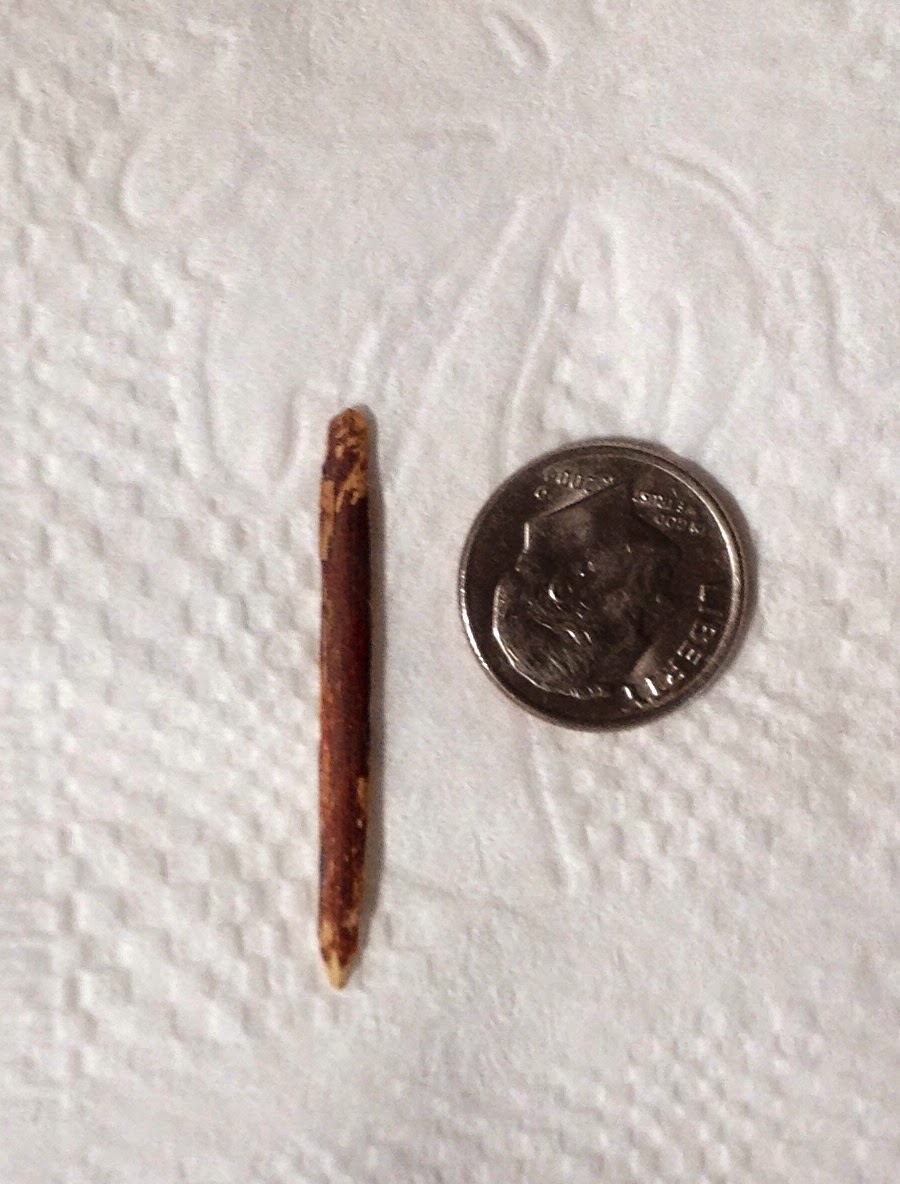
“It feels like there’s something under the skin where you have the boil,” I looked up at Mrs H. “Any chance you might have caught a splinter when you foot hit the door?”

Mrs H thought for a moment and shook her head. “No,” she paused and then her face lit up, “my mom pulled a splinter out of my foot when I was a child.”

“Oh, what happened?”

“My brother and I were jumping on the bed. My foot got cut on the bedpost when it hit it as I fell. I told my mom there was something stuck in my foot. She said she pried out a piece of wood when she bandaged my foot.”

“Interesting,” I tried to figure out how a story of falling off the bed at the age of five related to her current problem of foot pain forty years later.

“You know, doctor, this foot has always acted up. I used to tell my mom that I thought there was still a splinter in my foot but she could never find anything when she poked around.”

“Oh?” Apparently there was more to the history with her foot than I’d originally assumed.

“Yes, doctor, my right foot has always been prone to getting a boils.”

“So this isn’t the first time you’ve had an abscess on this foot?” the light was beginning to dawn on my consciousness.

“Now that you mention it, I had something like this last year too.”

“And you’ve been seen at the doctor’s office before for this abscess and they’ve never found anything?”

“I just take the medication and it seems to go away but never completely. I get pains in the foot on and off. I have to wear shoes with socks because I can’t stand for the straps from sandals or slippers to rub on the top of my foot.”

The story was becoming more complicated. More than a one time infected skin abscess. “Do you mind if I numb up this area on your foot and see if there’s anything I can find? It feels like there’s something like a splinter or toothpick in your foot.”

Mrs H agreed to my exploratory mini operation. After numbing the area with local anaesthetic, I nicked the skin over the strange solid thing that I’d felt on my exam. If nothing showed up on x-ray, it must be something organic stuck in the foot. With a fine forceps I dug into the tissue and snagged the object I’d felt.

“It looks like you’ve been keeping half a toothpick in your foot,” I pronounced to Mrs H with a triumphant smile. I held out the forceps that now grasped almost an inch long wooden splinter extracted from her foot.

Mrs H adjusted her glasses and leaned forward for a closer examination.

“It looks like you were correct. You did still have a piece of that bedpost in your foot. You want to take it to show your mom that you were right?”

Mrs H laughed. “After all these years…”

“You’re foot should heal up properly now. Without that piece of wood irritating the tissue, you shouldn’t have any more problems.”

“Wow, doctor. That’s great.” She continued to smile, still somewhat in shock, I think. She had me put the wood in a plastic wrapper for her; and in fact, did take it home. I can only imagine what she told her family.

Moral:
1.     Things are not always as simple as they might appear at the onset of a clinical situation
2.     Don’t try to keep a splinter in your body for years – it festers!


“Why do you see the speck that is in your brother’s eye, but do not notice the log that is in your own eye? Or how can you say to your brother, ‘Let me take the speck out of your eye,’ when there is the log in your own eye? You hypocrite, first take the log out of your own eye, and then you will see clearly to take the speck out of your brother’s eye.” Matthew 7:3-5


“As you slide down the banister of life, may the splinters never point the wrong way.” –Irish Proverb


**All identifying data including specific circumstances altered to protect identity.

Sunday, January 4, 2015

On Doctoring Around the World...


A/N: Well, dear readers, not sure how this blog posting turned out. These are my first patient-client reminiscences since coming back from Africa. Will writing about my experiences in America be interesting and insightful to you or will they lack the exotic African edge?  You’ll have to let me know. Thanks for all your support and encouragement over the years! A new chapter has begun for me.

On Doctoring Around The World

Doctor.

The word is almost universal.
The syllables, rhythm, and enunciation are nearly ubiquitous around the world.
Call out the term, ‘doctor’, in almost any country and any passerby will immediately understand that you want medical attention – and fast. It’s a term that conjures up illness. Urgency. And, hopefully, kindly concern for humanity.

He was sturdy and rugged**. Not young but certainly not elderly and frail. The calluses on his hands bespoke of someone used to daily manual labour.

“Where do you work?” I inquired as I sought to grasp a more complete picture of my new patient. I’d just started work back in the United States and was seeking to figure out how to reintegrate myself as a professional primary care physician. I needed to understand the American culture and how to connect to my new community of Pacific Northwest natives.

“I work at Fred Meyers (huge department store),” he shrugged his shoulders. It was a job and paid his bills. He didn’t seem particularly attached to his job and yet he wasn’t unhappy in it either. “I do a lot of walking. I walk to work. I am on my feet most of the day in retail sales there, and then I walk home too. People ask me how I keep in shape.”

I glanced at his BMI, a healthy 24. “Oh?” I ply him for conversation with genuine curiosity. His success story is one that I may remember to pass on to others after him. “What do you tell people when they ask how you keep your weight under control?”

He smiled at the compliment. “I don’t do anything special. I just walk a lot and started eating more fruits and vegetables. Nothing fancy.”

“You don’t work out at the gym or anything?”

“No. I can’t afford that, doctor.” He laughed nervously. “Till last month, doc, me and my wife, we didn’t have no health insurance. Haven’t seen a doctor in years.”

“Really?” I raised an eyebrow and tried to listen, keeping half an eye on him and the other half focused on the computer screen while I keyed in orders for his blood work. While electronic medical records have many pluses, easing the burden of information data entry is not among them!

PJ graciously allowed me to continue entering information while he related his story. “My wife’s been worried about me since I’ve been having all this numbness in my body. My hands and feet especially. Sometimes my feet get so numb that I don’t really feel them.”

“How so?” I glanced up at him and tried to type and focus at the same time. “When you have these symptoms of numbness, how does it affect your daily activity?”

“My body just feels numb. I can’t feel my legs and hands. Sometimes makes me think I might stumble when I’m walking a long ways.”

“Hum?” I try to sound halfway intelligent, like I have a clue what he’s describing when in actuality my brain is still trying to translate his description of the problem into medical symptomatology that I can sort into a differential diagnosis. It’s a bit like translating from one language to another. English to Latin perhaps? I have to intake the words that he uses in the context of his experience and digest them into a pattern that is recognised in a medical dictionary.

“Tell me more,” I encouraged him as I continued my exploration his problem. “How long has this been going on, PJ? Is it getting better, worse, or staying the same? Anything seem to make the numbness worse?”

Thankfully, PJ is happy to comply with my questions. I am grateful for the extra time I have as I begin my new job at the American clinic.

I remember back five years when I was first starting out in a new culture and language in Cameroon, West Africa. Pidgin was the common language that my patients spoke there. It took me months to begin to comprehend what it meant when an elderly lady complained of ‘ma skin de hot me fo all my body’ or a pregnant woman stated ‘I spit too much’ or a mother said ‘I have fever but it doesn’t come out’. The art of medicine, of listening as a physician, involves so much more than is taught in the lecture halls or the thick dusty medical reference books.

“So this is a problem that’s been going on for about 8 months now, not really getting better or worse, and mainly affecting your feet and hands?” I summarised. “Have you been worked up for this problem anywhere else?”

He shook his head no. His swaying grey hairs assured me he’s not been seen elsewhere for his current concerns.

Almost apologetically, as if he’s afraid I might scold him for not coming in sooner, he continued. “I know it been a while, my wife and I just haven’t been able to afford to see a doctor for a few years.”

He doesn’t need to apologise or explain further. I nodded. I understand his plight. Since coming back from service in Cameroon, in a bustling city centre where almost everyone could afford to see a GP at the government hospital or at least a neighbourhood nurse (granted there were some questionable levels of quality medical training and care…) it seems strange to be back in a country where not everyone can get health care if they want. A simple antibiotic for the part-time mother employed at a fast food chain is a near impossible hurdle for some.

My mind bounces back to two days prior when I stout Mexican woman proudly informed me that she’d just finished paying off her debt for her hospitalisation over two years ago. She had no idea what the total cost of the bill was; she shrugged and gave me crooked smile and said she just paid the $75 dollar per month payments that the hospital’s financial department had set up. She’d received word a couple months prior that it had been paid off. She was very happy.

Of course, I’d congratulated her, as she was clearly quite proud of her accomplishment. Inside though, I was a little sad because I have recently learned that too many of my fellow citizens are unable to pay off their hospital debts. Numerous studies that I have read online all have found that the number one reason for bankruptcy in the U.S. is from unpaid medical bills. A study in 2013 by NerdWallet Health analyzing data from the U.S. Census, Centre for Disease Control, the federal court system and the Commonwealth Fund predicts that 1.7 million will file for bankruptcy protection due to medical bills and outside of this another 56 million will struggle with overwhelming medical claims, that’s 20% of the U.S. population between 19-64. It’s hard for a missionary doctor to accept these statistics sometimes. I know it’s the reality but it doesn’t mean I like it.

For now, I concentrated on my new patient, PJ, and understanding his illness in the context of his circumstances. “What is about your symptoms that worry you? What are you afraid you might have?” I asked PJ. “You mentioned you’ve gone on the Internet and talked with your friends and wife? Is there something you’re afraid that you might have? Something your wife is concerned about?”

PJ shrugged a little embarrassed. He’s a private individual. Male reticence perhaps? “I don’t know. I’m still figuring out the culture in my new community. “You’re the doctor.” He hesitated. Clearly he did have some ideas and fears.

“Yes?” I encouraged him to express himself so I could understand.

“Well, you know, doctor,” he paused again. Then finally he added cautiously, “Some people have mentioned diabetes, vitamin deficiency, MS…” his voice trailed off.

“Cancer even?” I gave him words for his worst fears.

He nodded.

I glanced over at him and then finished typing. “Well, now that you are in the system, you’re in.” I assured him with a smile. “Now we can check everything out and figure out why you’re having the symptoms that have been bothering you for too long.”

He gave me a tentative quick smile.

I got up and did my usual physical exam. A head to toe exam that is the same in Africa as America. There is something comforting to using my stethoscope to auscultate the breath sounds of the lungs or the heart rhythm through the chest wall. It’s universal. Healthy bronchial breath sounds are the same anywhere I practice medicine. It makes me feel less homesick when I do my hands on physical.

“So far, everything appears normal.” I straighten up from my exam. “We’ll do some blood work to make sure you don’t have any diabetes. We’ll order all the tests to get you caught up on your cancer screening too. Before you leave, the nurse will give you your flu and tetanus vaccinations.”

He gives me a grateful smile.

“Don’t worry,” I tried to assure him that I cared and convey my desire to help alleviate his health fears. “You’re in good hands with your new health insurance. We’ll get you all caught up on your preventative health care and figure out your health problems now. We’ll take care of you.” I look up at him as I complete all the computer entries for his labs and vaccinations.

PJ is seated on the edge of the exam bed. He is smiling. His clear blue eyes framed by wrinkles formed over years of hard work begin to swim. Tears threaten. He catches himself before they spill over. And yet, his voice cracks ever so slightly. “Thank you, doctor,” he catches my hand as I reach out to solidify our relationship – primary care doctor and client-patient. A strong, firm handshake. Two strangers agreeing to work together toward health. Two strangers both coming back to the organised network of American managed healthcare.

“Thank you,” he huskily echoes.

“You’re most welcome,” I heartily assure him.

Truly, I am grateful for the reminder. He reminds me that I have a mission to care for people no matter what culture or country I find myself serving. My mission is not confined to a particular corner of the world. Sick people are everywhere. And anywhere I go, I will find those underrepresented and underserved who need an advocate to voice their story. They need a translator to hear their fears and address their health concerns. Whether in an “under developed” country or a “developed” country I can still be a missionary, an ambassador for Christ through loving medical ministry.


**Names and identifying information are changed to protect privacy.