Showing posts with label Student Missionary. Show all posts

Saturday, September 6, 2014

Taxi Church

\


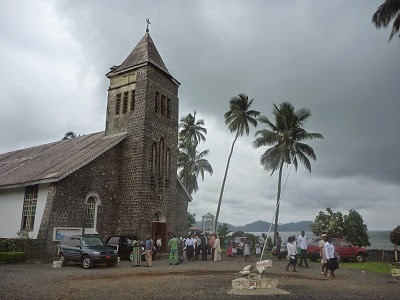
“I'm not sure we're going to make it to the church service after all,” I shrugged helplessly and gave Arnoldo a knowing nod as we surveyed the barely half-full minibus. Standing in the muddy car park on a Sunday morning, the two of us ignored the persistent pleas of the bus driver to climb into his minivan. The van would not leave until the seats were taken, aka. 'the bus don flop'. At the rate it was filling up, this could be a while. We were anxious to make it to Limbe to a Catholic mass by the seaside at one of the oldest missions in Cameroon, Bota Holy Trinity. 

Public transport is not always as speedy as one would hope.

“Douala?” a young man urgently shoved his inquiry toward us, anxious to take on another passenger. He pressed forward and tried to herd us like a pair of sheep toward his empty vehicle. 

“No, Limbe,” I refused his offer and scanned the car park again for any other vehicle that might be headed to the beach town sooner. 

The young scout slipped away, lost in the flesh of other anxious young drivers going to Limbe who'd suddenly heard their prompt. 

“Limbe, Limbe!” the man yelled excitedly. He ushered us toward his waiting 'clando' – a private taxi car that he will fill with four passengers in the back seat and two in the passenger seat up front before departing. These clando taxis can fill faster and are sometimes an expedited means of reaching one's desired destination. 

I looked dubiously at his vehicle. There was one elderly gentleman settled in the front seat. With Arnoldo and I, that would mean three more passengers before he'd go. 

I waited, not yet convinced at the drivers insistence, “We're going now, now, like this!” He was still searching for more customers as he proclaimed his imminent departure, waving his arms dramatically. 'Now' is a relative term.

The minutes ticked by and I looked at my watch. “Well, it might be that we are there just to see the church. The service might be over by the time we make it to Limbe,” I tried to look on the bright side. “It will still be an adventure.”

Suddenly the driver's tone ramped up a notch in urgency.  “Enter, enter,” he almost physically pushed us toward his clando. “See, ee de flop. We de go  now. Enter!”

Out of the periphery of my vision, I noted two well dressed women enter the car. The smaller woman was dressed in an cream-colored suit with matching hat – a very stylish hat trimmed with lace and angled jauntily on her head. It reminded me of photographs of certain  British royalty. The woman situated her purse in her lap and folded her hands over her small Bible. 

The other woman did some fast negotiations with the taxi driver and the elderly gentleman in the front seat. She was a much larger woman, actually. Amply cushioned as some might say. She was dressed in high-fashion too. She had on a tailored dress fashioned to accentuate her curves. The material was of the latest design and high-lighted with shiny gold accents. Her head wrapper added an additional six inches to her height. With the air of a queen, she situated herself unashamedly into the front seat while the small elderly gentleman happily stepped aside and moved himself to the back seat. She had that air of regal confidence. 

Recognizing that the taxi was indeed, now full, I gave a nod of agreement and climbed into the back seat of the car. Four in the back seat. We were cozy and ready for the drive to Limbe at last. As the elderly man squeezed his body and shifted toward the middle a bit more in an attempt to close his door, the elegant woman in front turned round to survey her company behind. 

“Ashia, Pa,” she gave the elderly farmer a gracious smile. 

“Thank you, mom,” he smiled up as he succeeded at least in getting the door to latch.

“I can't fit behind. Now I paid for two seats in front.” She smiled broadly. “I'm very comfortably situated now.”

Knees and elbows jabbing into each other in our cramped quarters in the rear of the car, all four of us nodded in agreement. Yes, she did seem comfortable in her front seat. 

Content that he now had a full vehicle, the driver kept quiet as he concentrated on the road. The incredibly green fields of the Tole tea bushes rushed past our window as he drove. A short quiet ensued as everyone sat ensconced in their own thoughts. Suddenly, the woman in the front seat turned slightly. “Today is Sunday. I want us to pray.”

“Amen,” her friend concurred. The elderly man nodded in agreement as well.

“Turn with me to the book of Numbers in the Holy Bible,” she began.

Of course, none of us could actually get out our Bibles and turn the pages given our incommodious quarters but this did not deter our front-seat preacher. 

 Confidently she dug into her purse and pulled out her small white, leather-bound Bible. She turned the pages and left them open on her lap. As she began to expound upon the story of the rebellious and ungrateful Israelites grumbling about wanting meat to eat, I wondered how she was going to turn this into a prayer.

“Now the people complained about their hardships in the hearing of the Lord,” she proclaimed, “Amen?!”

Her friend next to me murmured an agreeing “Amen.”

“...and when he heard them his anger was aroused...' “Praise the Lord?!” 

“Praise the Lord,” the elderly man reflected back. 

“'...Then fire from the Lord burned among them and consumed some of the outskirts of the camp...'” our taxi preacher was gaining steam, “Amen?!”

“Amen,” several passengers nodded.

Her exhortation continued at this enthusiastic fiery pace with loud exclamations soliciting the captive audience's participation. 

“'....Moses heard the people of every family wailing at the entrance to their tents.'”... Praise the Lord!” 

“Praise His Name,” we echoed.

“'... The Lord became exceedingly angry, and Moses was troubled.” Amen?!” 

“Amen,” even the taxi driver chimed in.

I still wondered where the spiritual lesson was going to be in her semonette. 

She continued on to verse 23 of Numbers chapter eleven, “The Lord answered Moses, “Is the Lord’s arm too short? Now you will see whether or not what I say will come true for you.”

“Amen?!” She breathed dramatically. 

“Amen,” the chorus echoed from her back-seat audience. 

Our eloquent taxi preacher tilted her head toward the driver. He kept his eyes on the road and gave her an affirming grunt of affirmation to continue. 

“Isn't God great?” she shouted in enthusiasm. 

“All the time,” we answered with a murmur of nodding heads.

“God is great. Amen?! From this passage we can see that whatever be the problem, God is able to deliver us. Praise the Lord! Amen! Here we see that God is telling Moses that He is not weak. He is mighty,” and her she paused for emphasis, “God is more than capable of delivering us from any problem that we might have – no matter the problem, whether it be financial problem, whether it be family problem, whether it be health problem, no matter  – whatever problem we might have, God is able to deliver us! Amen?!”

She paused to catch her breath, wiping a few beads of sweat that had formed on her forehead. 

“Amen?” She turned to partially face us seated behind her. “ No matter the problem; God is mighty and able to save us. Amen?”

“Amen,” we sighed in reply to her exuberance. 

“Isn't God good?”

“All the time,” everyone in the car answered.

“Amen,” she leaned back in her front seat and studied the words opened before her in her Bible. “We have nothing to fear. Just like God was able to deliver the Isrealites in the Bible, He is more than able to deliver us from whatever problem that we have.”

She folded her hands, satisfied. The verdant green vegetation of the tea plantation fields gradually transformed into the tumbledown wooden houses and dirt yards indicating that we were nearing Limbe.

“The Word of the Lord has spoken. Praise the Lord.”

“Amen,” we murmured in union. 

“Let us fold our hands and pray to our mighty Father in Heaven who is able to solve all our problems.” She raised her own right hand as she bowed her elegantly wrapped head. 

“Father in Heaven, we pray – we pray for your protection as we go to our various destinations. We pray, Father, we pray, that you watch over the driver and keep us safe as we travel. Keep us under your protection, we pray. We praise you that you remind us in the meditation today that you are our Deliverer. And, no matter the problem, you will deliver us.” 

She paused, head bowed, letting the words of her prayer sink in. “In your mighty Name we pray, Amen.”

“Amen,” the rest of the taxi raised their heads from joining her in prayer.


Arnoldo and I reached Limbe safely. We parted ways with our energetic taxi-pastor and her companion at the drop-off. The Catholic service was just beginning as we entered. I believe the sermon was about the Apostle Peter and the cornerstone of the church. It was a lovely picturesque setting for the church service. The waves rolled gently to and fro along the sandy shores. The salty sea breeze wafted through the rafters of the high vaulted ceiling. The choir's voices sang melodiously 
in the apse of the building. 


Two sermons in one Sunday morning. It was a blessed day.


“The Lord answered Moses, “Is the Lord’s arm too short? Now you will see whether or not what I say will come true for you.”  Numbers 11: 23


Wednesday, April 2, 2014

Dyspnea


I’m supposed to write something inspirational. Something uplifting. Encouraging to the soul.

I don’t feel like writing anything cheery.

She’s dead.

I knew she was going to die. I could see it in her eyes. The heaviness. The weariness.

Pleading.

A resigned exhaustion.

Haunted by her existence.

Yearning for her release.

The look of death.

Yeah… this isn’t turning into a bright and happy piece of writing, is it?

Madam H was 50 years old. She came early in the morning. Too early in the morning. Concerned relatives had packed her into the car and shuffled her from hospital X to our health centre after she failed to respond to the treatment regime she was receiving.

“Coming,” my husband unlocked the front door. We were both trying to rejoin the land of wakefulness at the early hour. Jordan, our dog, had alerted us to the nurse on our front porch with her usual energetic barking. (No need for a doorbell. Most visitors don’t even realise we have one)

“It’s the nurse,” my husband called back to me.

“What does she want?” I inquired. I sighed. Already? Couldn’t the consults wait for another hour until the clinic actually officially opened?

“I don’t know. She wants to see you.” My husband relayed the message.

“Tell her I’m coming. I’ll be over in the hospital in a few minutes.” I hurried to finish dressing. Mornings come too early.

With a growing sense of trepidation, I threaded my way to the hospital through the milieu of animated visitors who invariably come along with a sick patient. It’s actually a little intimidating to walk past the crowds of them… all waiting and watching with expectant gazes for the white doctor. Their heads turned in unison as I passed them. I ducked away from their intense stares into the general adult ward in the hospital.

Madam H was positioned in a semi-upright position with the head of the bed cranked upright. She gasped like a trout out of water for air – hungry, mouth-open, inhalations -- without finding relief from her oxygen deprivation.

“What’s the story on Madam?” I turned to the night duty nurse.

“Difficulty breathing, doctor,” the night duty nurse gave me the very abbreviated version of the patient’s medical history.

“Anything else?” I pushed for more details.

“Doctor, the family says she can’t breath. She’s been taking medicines to no avail. They brought her here because of severe neck pain.”

“Oh?” I bent over and placed my stethoscope on Madam H’s chest, listening to the air enter, listening as some unseen force halts her efforts at breathing – preventing her from taking a long, deep, satisfying, lung full of air. No crackles. No wheezes. Just rapid, gasping breathes… not shallow but not deep and gratifying either.

“How long has she been like this?”

“Ten days.”

I stared incredulously at Madam’s troubled breathing. “She’s been breathing like this for 10 days?!” I raised my eyebrows, not quite believing.

The night duty nurse looked at Madam’s medical book in her hand. “Yes, doctor.”

“And what has the family been told is the problem?” I counted Madam’s respirations. Forty breaths per minute. Not as bad as I’d initially thought. Her heart was beating regular with a pulse of about eighty. She had a little swelling in her legs but not much.

“They said she has pneumonia, doctor.”

“Can I see which medicines she’s been taking? Do they have the other lab results from the hospital?” I turned my attention to the plastic sack of medications at the bedside cupboard. Augmentin. Tot’heme. Terpone cough syrup. Ventolin inhaler spray.

I addressed Madam and held out the Ventolin spray to her. “Take,” I instructed, “then tell me if it helps you breath better.”

Without wasting air to reply, she deftly took the Ventolin asthma spray and inhaled a few puffs.

“Did it help?”

“She looked at me with vague eyes and gave a noncommittal nod of yes.” I wasn’t impressed. Certainly not a dramatic improvement. She still put enormous effort into every breath.

“Doctor, she complained of neck pain and chest pain,” the nurse reminded me.

I nodded at her words. “Any fevers?”

The sister shook her head, “No, doctor.”

“Cough?”

“No.”

“Headache?”

“No.”

“Any pain anywhere besides her neck and chest?”

“No.”

“Does she have asthma?”

“No.”

“Has she ever had diabetes or hypertension?” I noticed that her blood pressure was up. The last reading on the blood pressure machine was 160/105 mmHg.

“No, she has never had high BP,” her sister looked around at the other members of the family who offered nothing to the alternative.

“Did her breathing problem come on slowly or did she get difficulty breathing quickly?”

“It just came like that,” her sister tried to explain. “It has never happened before.”

“So, she just woke up suddenly with difficulty breathing?”

“Yes, doctor,” the sister answered with hesitation.

“Has the treatment improved her breathing at all?” I looked around at Madam H and the rest of her family. Madam was busy breathing so I relied on her entourage to fill me in on the details.

They all shook their heads empathically. “No, she has only been having this difficulty to breathe, doctor.” The sister spoke on behalf of the crowd.

“Can I see her medical books and laboratory tests?” I sat down at the nurse’s station with an assortment of papers, receipts, several paper booklets, and a chest x-ray.

HIV negative.

Random blood sugar, 117.

Malaria negative.

Chest X-ray report read, ‘bilateral pneumopathy’.

‘for right breast biopsy’… huh?

“Did they do a biopsy of her breast?” I was confused. Why was there a work up for a breast lump going on in the middle of a hospitalization for shortness of breath?

“I don’t know, doctor,” the sister answered with a shrug.

Strange. I would peruse her books a bit more but for the moment Madam H, her family, and the night-duty nurse were anxiously awaiting a plan of action.

“Check the Hb (haemoglobin level). She looks a bit pale.” I instructed. “Then tell the family to repeat the chest x-ray.”

Surprisingly, the Hb came back normal – 12.2 g/dl. The chest x-ray, when compared with the picture from 10 days ago, looked very similar. This time the report read, ‘bilateral pneumopathy with small pleural effusion’.

I wrote orders for IV antibiotics and furosemide (diuretic). The underlying question remained though – why was Madam having pneumonia that wasn’t responding to appropriate oral antibiotics? Where was the pleural effusion coming from? Why wasn’t she having any fevers? Was the neck and chest pain related to the lungs or the heart or something else?

Time is a funny thing in medicine. It can pass in what seems like one blink of the eye or it can drag on forever, counted second by endless second with each laboured breath.

“How is she?” I came to check on madam in the afternoon after most of the consultations on the outpatients were finished. “She’s ok, doc,” the nurse shrugged without enthusiasm. “Her blood pressure is high.”

“How is her breathing? Any better?”

“Not really, doc. She’s complaining that the Lasilex makes her chest pain more when I give it.”

“Ok,” I acknowledge this odd factoid.

On examination at the bedside, I found madam sitting up. “Does she breath better when she’s sitting?”

“Yes,” the sister confirmed.

Her oxygen saturation was 99%. Her pulse and blood pressure were relatively unchanged. Respirations were still laboured. Her lungs on auscultation with my stethoscope sounded the same. No change. And, she still didn’t have even the faintest hint of a fever. I examined her conjunctiva. White.

“Check her Hb again,” I requested.

I searched through her records again. I found evidence for a ten-year history of breast pain and a small surgery with excision of a breast lump several years ago. Otherwise, I could not find anything new. I didn’t know what to think.  Her symptoms did not add up to equal simple pneumonia. They didn’t fit a simple pleural effusion either. In spite of producing plenty of urine, her breathing had not improved at all. My mind stared grasping for other explanations. Pulmonary embolus? Heart attack? Cancer? Pericardiac effusion? Pericarditis? Parapneumonic effusion? Questions; no answers.

I felt like an idiot. The family stared at me like I was an idiot too. How come the white doctor couldn’t tell them exactly what was wrong with Madam H and fix her? Their silent stares and background animated chatter felt eerie and accusing every time I passed the hospital entrance.

“I feel like I’m missing something.” I lamented to a friend online. “What is it?”

She graciously messaged with me and helped alleviate my insecurities. I felt somewhat more confident that at least my line of reasoning was logical, medically speaking, afterward.

I plunged forward with my questions and investigations while Madam H continued to struggle to breath. She was able to sleep and relax a bit when we gave her oxygen. I left the oxygen concentrator next to her bedside. Anything to alleviate her air hunger and discomfort even though it wasn’t the solution.

I took photographs of her chest X-rays and emailed them to another friend for reassurance that the local radiologist and myself weren’t missing anything significant on the films.

An ultrasound doppler study of her leg veins failed to show any blood clots. The sonographer didn’t feel there were any signs of a dilated right heart ventricle or atrium. “It just looks like congestive heart failure.” She gave her opinion of the ultrasound study as I discussed it with her.

So… no definitive answers.

“What was the repeat Hb?” I stood at the nurses station trying to decide what else to do. Nothing seemed to be helping.

“Her Hb was 13.3 g/dl,” the nurse informed me.

“How can that be?” I asked, still not believing. “She’s white. You’ve seen her, right?”

“Yes, doc.”

Madam H’s conjunctivas were white, her tongue was pale, her fingers appeared bloodless. I searched my memory banks for anything that would make her Hb falsely elevated. And yet, her pulse was not tachycardic. Her blood pressure was high; not low. The haemoglobin metre had churned out appropriate low values of 8.7 g/dl and 9.9 earlier.

“How are you?” I walked over to Madam H’s bedside and addressed her. During her entire stay, she’d barely uttered more than a yes or no. All oxygen was savoured in favour of expending her efforts to breath.

She stared at me with tired eyes. I didn’t need her to tell me. She wasn’t better. She was worse.

I checked her oxygen saturation. Sitting straight up with her legs dangling over the side, the oxygen saturation levels rose to a meagre 89%. When she leaned back into the bed, in spite of the inclined head of the bed, her saturations dropped to the 70s. Not good.

“Can you think of anything else?” I turned to my nurses at their station.

They shook their heads. “Doctor, I think we need to transfer her.”

Wearily I agreed. She was clearly not improving.

“We’ve tried everything we can here at our small health centre…” I began as Madam’s relatives sat opposite me in the make-shift family conference room. “I don’t know what all is causing her difficulty breathing. It’s more than a simple pneumonia though. She needs to go to the big hospital in D_____ where there are more specialists and capabilities to treat her.”

“You’re right, doctor,” one of the male relatives spoke and nodded.

“Don’t waste your time going to the other small hospitals. Just go to D_____ now. You’ve already been to one other hospital and I know the hospitals here in Buea are not big enough to do anything more than we’ve done for her here. Go to D_____.”

“Ok, doctor.”

We wrote up the appropriate paperwork and helped the family load Madam H into the waiting taxi.

I was relieved that she was going somewhere that could do more for her. I was frustrated that I couldn’t help her. I felt drained and apathetic. Discouraged. Empty.

I couldn’t even figure out what the real problem was. She was dying and I didn’t have a clear picture of what was really happening. There could still be a pulmonary embolus. Perhaps it was heart failure from a recent heart attack… maybe it was complications from breast cancer…. a resistant pneumonia… anaemia (even though our metre pointed to an alternative diagnosis she still looked very very pale). Too many questions. My mind wouldn’t stop processing Madam’s case. In spite of my musings, the meagre facts of the case swirled around without coalescing into any solid diagnosis. Like a computer trying to open a bad file, my brain whirled endlessly and fruitlessly. No program loaded. No answers popped up.


These types of medical cases are difficult. They drain my psyche insidiously and poison my confidence. So much effort with no return on the investment. I knew I’d probably never hear from the family again. I’d sent them off into the mysterious depths of the system of specialists in D_____. Historical experience informed me that there was a 95% chance I’d never know what happened.

Postscript:

The family took Madam H to another nearby hospital in Buea. They did not go to D____. At the hospital, they were again referred to D___ but instead chose to remain. Madam died at in the hospital the next day. The impression by the doctors at the other hospital was that she died of congestive heart failure brought on complications from breast cancer.

One may be tempted to lay blame on the family for not transporting her to a big, expensive specialty hospital where she’d have the best chances of survival. However, perhaps the family, like myself, saw the ‘handwriting on the wall’. Knowing that she was near death, they chose to let her die in her hometown and save the resources it would have cost just to get her through the front gate of the D____ hospital. Contrary to certain cultural attitudes in other parts of the world, there are financial limits and medical care is not an unlimited resource.


 “Who comforts us in all our troubles, so that we can comfort those in any trouble with the comfort we ourselves receive from God. For just as we share abundantly in the sufferings of Christ, so also our comfort abounds through Christ.”
2 Corinthians 1:4,5


Tuesday, July 30, 2013

Eye Trouble

Young patient at the Buea Seventh-day Adventist Outpatient Clinic


“The King will reply, ‘Truly I tell you, whatever you did for one of the least of these brothers and sisters of mine, you did for me.’  Matthew 25:40

EYE TROUBLE

“Where’s the baby with the big eye?” I turned to one of our nurses as I walked rapidly back from the hospital to our overflowing outpatient clinic where nurses and doctor see twenty to thirty patients per day, sometimes more if it’s a Monday.

The nurse shrugged. “I don’t know which patient you mean, doctor.”

“You know, the little boy with the red, puffy eye – it was almost swollen shut. He was sitting in the waiting room earlier in the morning.”

“Oh, that baby,” the nurse answered with sudden recollection. “I gave him some eye ointment. They didn’t want to consult the doctor. ”

“What?” I stopped. “He had orbital cellulitis. I could diagnose him from across the room. He needs intravenous antibiotics.”

“It was an antibiotic eye ointment,…” the nurse’s voice sounded hopeful.

I shook my head. “No, it’s not enough. Have you ever seen orbital cellulitis before?”

“No, doctor.”

“It’s an infection around the eye. Because the eye is so close to the brain, the infection can spread. If left untreated, it can cause blindness or even death.”

The nurse was silent. We walked in stride back to the clinic teaming with clients returned from the laboratory and impatiently waiting to receive their diagnosis and prescriptions so they could go home and recover. I pulled down a well-worn green paperback from my office shelf. Flipping through the pages, I found the particular section I wanted. “Here, read this about orbital cellulitis.” I pointed out the appropriate paragraphs. “Let me know when you finish reading.”
~oo~
Buea is a town of about 200,000 inhabitants from a diverse background – farmers, government civil servants, university students, and foreign volunteers. Our little health centre consists of an outpatient clinic containing a pharmacy and several consultation rooms. There is also a larger building that contains an eleven-bed hospital complete with a delivery suite and theatre (operating room). The laboratory is housed in the hospital.

The health centre has been serving the people of Buea since 1971. In 2012, the long anticipated hospital building opened its doors to 24/7 hour emergency services, admissions, and infant deliveries. We’re not a large operation but it’s enough to keep one doctor busy.

As we grow and new staff and international volunteers join the health care team, the challenge is to remember our mission statement: “As Jesus loved and served, it is our mission to serve and love the people of Buea by providing access to world class health services and education; and to encourage our clients to total health: spiritual; physical; emotional; and intellectual.”  It’s not always easy but certain instances happen that remind me we can still maintain our commitment to excellence.

~oo~
I was wiping down my exam table with a spray bottle of eau d’javel (bleach) that was stubbornly spurting erratic streams of disinfectant when the nurse returned with an anxious frown on her face. “Doctor, I’m so afraid! I didn’t know…”

The nurse who saw the little baby with the eye infection was back. She finished her assigned reading. Her eyes filled with tears and her face expressed anxious concern for her former patient. “It’s ok,” I reassure her. “It’s a learning experience. Now you know. You won’t forget.”

She nodded her head.

“You need to call the patient’s family and have them bring him back for proper antibiotics now.”

“Yes, doctor,” she hurried off to look up the client information in our register.

A few minutes later she returned with a frown. “Doctor, the phone number is not correct.” She wrung her hands, obviously quite disturbed.

“Well, we’ll pray that the family brings him back.” I try to console her. “We’ve done everything we could.” The nurse hangs her head miserably. “But what if…” her voice trailed off. She’s read about the complications of untreated orbital cellutlitis.

Administrative concerns distracted me for the next several hours. The missing baby with the eye infection slipped my mind as I discussed quality control indicators and quarterly business plans. It was almost five o’clock by the time I was free. “Doctor, he’s back.” The nurse held a medical booklet in her hand.

“Who’s back?” I asked, momentarily confused.

“The baby with the eye infection.” She smiled, “we found him.”

“Praise God,” I answered with relief flooding my mind. “Let’s go see him and get the proper medicine started for him.” We walked together to the hospital where the baby and his mother were waiting. “How did the family decide to come back?” I was curious what prompted the family to return to the clinic so quickly since we had not been able to contact them.

“Oh, we went looking for them, doctor.”

“You went looking for them?” I echoed back, shocked.

“But how did you find him?” Our patients only give a neighbourhood when asked their address.  A neighbourhood covers hundreds of people.

“We went for a walk in his neighbourhood and asked everyone we saw if they knew where the boy with the big eye lived. Eventually someone directed us to the correct house.”

“But how long did that take you?”

“About an hour, maybe a little more.”

I am humbled at the dedication she and her colleague showed today. The two nurses went above and beyond their expected duties in their search for the baby. They put aside their paperwork and other duties they will have to catch up on later and, instead, spent their time wandering the dirt streets of Buea trying to find a sick little boy that needed further medicine.

The nurse and her willing colleague demonstrated God’s love in finding him and caring for him. To God be the glory for their compassionate, dedicated service to Christ and his children. I’m delighted to report that the little boy is healed now with no complications from his eye infection.


“Missionary zeal does not grow out of intellectual beliefs, nor out of theological arguments, but out of love.” - Roland Allen


Sunday, February 3, 2013

La Luna

Photo compliments of Bill Colwell Jr.

Ah La Luna La Luna
The night that we fell under the spell of the moon
Ah La Luna La Luna
The light that will bring me back to you
- “La Luna” by Belinda Carlisle

Within the complicated tapestry of life, one will inevitably cross over a few woven seams that serve as landmarks upon the quilt of our minds.  Occasionally someone will ask me why I’ve chosen to work in Africa. “Why waste your time and talents among the frustrations of the ‘dark continent’?” is a sentiment broached on more than one occasion. Let me tell you story – actually, let me relate an experience, an encounter, which I had more than thirteen years ago:

If one is willing and keeps an open-mind, there are moments – not hours - just moments, mere seconds, and if we’re lucky, perhaps minutes, when the curtain of our mortal existence is drawn back to reveal the indescribable eternal reality of the vast universe in which we actually subsist.  It is beyond description yet incredibly authentic and fills one’s inner core with such overwhelming sentiment as to defy all human logic. Rather like a glimpse into a fifth or sixth dimension by a human being who understands but a reality based in three dimensions – perhaps dimly comprehending a fourth.

Though this particular experience occurred many years ago, the scene is seared into my memory by the strength of its associated feelings. It remains vivid and true.  Yet in all honesty, I cannot properly explain it. Language, music, and pictures – all fail to convey the encounter - a magical moment when for a few brief seconds the universe seemed aligned and the future clear and certain.

I was a student missionary volunteering at a remote mission hospital nestled in the mountains that separated Tanzania from Burundi. I had been in the country for several months and was relatively used to the noise and bustle of a hospital filled with the characteristic cries of babies and chatter of patients with their endless stream of visitors. Since the hospital was part of a larger compound containing the houses of the staff, including my own volunteer house, it was rather like a small village. The population density, like most places in Africa, was such that one was never alone. As one traversed the area a continual crowd of children followed and other village folk walking from field to home or market were everywhere.

Tonight was different. I was out at an hour much later than usual and found myself strolling along the eerie and deserted barren slip of grass utilized as a landing strip by the tiny mission planes when transporting important people or emergency patient cases. Tonight the air was pleasantly cool. Not cold; but, of that quality that refreshes and enlivens the body. A tender breeze that was too soft to be felt through my clothing, ruffled the leaves in the towering eucalyptus trees that lined the far side of the airstrip, whispering faint echoes of the events of the past day.  The smoke of the day’s fires had cleared leaving behind the earthy aroma of dirt and grass to fill my subconscious with thoughts of green pastures and fertile gardens yielding crops of succulent vegetables.

However, I was only vaguely aware of these sensory inputs. Instead, my consciousness tuned into the curious absence of the typical sensory assaults. No screaming children’s voices floated in air. No motorcycles roared across the dirt sending up plumes of red dust and black exhaust. No goats bleated in passing, trussed up so as not to wander too far with fraying pieces of strings tied round their spindly legs. No farmers carrying bundles of dried sticks on their heads for the evening fire stepped with a resigned plodding pace, mumbling greetings in passing and then staring with wide, curious eyes at the strange white anomaly in their path. Although there was nothing wrong with these interruptions during the day, I found myself drifting peacefully and gratefully into a state of relaxation induced by this unexpected luxury of peculiar stillness blanketing the deserted airstrip.

As the bewitching stillness gradually seeped into my soul, I came to halt in the middle of the field. I let the atmosphere capture my imagination and enclose me in its captivating spell of silent wonder. The moon began to creep over the encircling hills and the soft, luminescent beams pierced the thick night’s blackness with an ethereal glow. The stars hung suspended in infinity. Sparkling. Shining. Smiling.

Then the moon rose to its fullness in the sky. A full moon. Its presence commandeered the night. If you have never seen a full moon at the equator, you have not seen the moon in all its glorious richness. The tilt of the earth at the equator makes the moon seem larger than anywhere else in the world.  Its light dwarfed the tiny starry sparks in the sky and spread across the empty expanse of the airstrip with an almost deafening roar. I couldn’t help but stare in awe at the massive reflector of brilliance.


All of a sudden everything seemed small and insignificant in comparison. My life was caught up in the wonder of it all. For a brief period my finite existence was inexplicably coupled with the infinite. I was interconnected to every other life force in the universe. I was not alone; yet a crowd did not overshadow me. Disappointments, despair, sadness, tragedy, frustrations, loneliness, and unhappiness, were oddly, swept away. The earthly reality seemed to shrink in proportion to the vast, endless spiritual reality that filtered through my consciousness. Somehow I felt certain that I was allied with the rest of the cosmos. I was an integrated player in the chorus of heaven, created in harmony with the rest of God’s symphony. Such a realisation and peace filled my heart that there are no words upon earth to describe it – a transcendence of the eternal through the limits of time and space.

Of course, I did not remain forever transfixed by the spell of this moonlit night. The moon rose higher into the sky and the stars came back into focus. The soft stillness of the night cushioned me in her arms as the magical moments broke and the curtain fell back in place, covering up the mysteries of the infinite once again. I returned to the earthly realities of a three dimensional existence.

From that experience, that encounter, a love affair was born. It is an affair with Africa that continues to this day. Admittedly, the magical moment that occurred thirteen years ago doesn’t happen often.  Yet, there are glimpses of that original night. Just as the moon cycles throughout the month with varying slivers of silver shining through the velvet blackness of the night; so too there are varying experiences that shimmer with glimpses from the other side of the curtain – a spontaneous smile from a happy child, an unexpected gift of thanks from a grateful client, the joyful exclamation of the grandmother over her new grandchild, the golden-pink hues of a beautiful sunset spreading over the outline of the mountains, the sweet taste of garden-ripe pineapple at first bite, the shiver of awe when a friend gives you a word of encouragement at the precise moment most needed, the delicate aroma of the night flowers wafting across the evening breeze –  these glowing embers  are reminders that I am part of something greater than my mortal eyes can perceive. I have been captured by the spell of the African moon. Every now and then, when the planets align just right, I gaze upward at night and am filled with that same wonderment that engulfed me many years ago.

~o~

“When I consider thy heavens, the work of thy fingers, the moon and the stars, which thou hast ordained; What is man, that thou art mindful of him? and the son of man, that thou visitest him?” 
Psalm 8:3,4


“This moment contains all moments.” C.S. Lewis


Listen as the wind blows from across the great divide,
Voices trapped in yearning, memories trapped in time,
The night is my companion and solitude my guide,
Would I spend forever here and not be satisfied?
- “Possession” by Sarah McLachlan

Thursday, January 10, 2013

SIMS Health Fair - Dec 2012

 Pictures from the four day health expo compliments of Bill Colwell, Jr.


Buea Seventh-day Adventist Health Centre was thrilled to host and work with a team of health care volunteers from Loma Linda University that came to visit from December 27 to January 05, 2013. During their time here, the team, made up of local and international volunteers, joined hands and worked toward the common goal of promoting health and healthy choices to the residents of Buea.

Among those on the team were 11 post graduates students from LLU, 4 faculty professors, 2 nursing students from Cosendai Adventist University, youths from our local church, and volunteers from HADY Guiding Services,  Live Build,  and Humanity Exchange (Hoptec). And of course, our own hardworking staff sacrificed their holiday time to help out at the fair. It was truly a team effort.

During their time in Cameroon, the team accomplished several outreach activities. These included:

1. Heath Expo - four days of health screenings and counseling. Participants underwent several screening exams that included blood pressure, blood sugar, cardiovascular endurance, oral health, pulmonary peak flows, and BMI. They learned about the importance of rest and enjoyed a massage even! At the end, each participant 'graduated' with a personal health passport with the results of their screening tests that assisted the health counselors as they spoke in groups and one-on-one with folks about how to improve their health.

2. Free HIV Screening - one day the team went out into the local community and performed free HIV screening and counseling. Over 70 villagers were screened and counseled.

3. Orphanages - the team enjoyed a mutual blessing at two local orphanages as the children played and entertained the members while LLU brought needed supplies and even some fun toys to the children.

Once again, an enormous thank you to all who sacrificed their time and holiday to participate in this successful health promotion!

Wednesday, January 2, 2013

Blood on Table


People speak of a ‘pools of blood’ at a murder scene. A body on the ground, blood slowly trickling out at the site of the fatal wound. This - this puddle on the examination table in my office - was not a small pool from a trickling wound. It was a heap of lumpy, coagulated, blood-goo.

Under the brilliant jabs of light from the flashing of fluorescent overhead tubes that couldn’t manage to fully flick on, I surveyed the scene before me. I’d just completed an emergency ultrasound for a pregnant woman. It was a sad and desperate ultrasound. She had been referred to our health centre because of dire circumstances. Her doctor back at the general government hospital knew that we had the only accessible machine for the next forty-eight hours -- until New Year’s Day holiday festivities were past.

Madam was thirty-one weeks pregnant. Up until today, everything was normal. Now her world was flipped upside down and turned inside out. Despite an ingrained cultural ability to keep a platonic expression on the face during emotional turmoil - even I could discern her distress.

“Are you bleeding a little or a lot?” I asked her as she climbed up onto the examination table for the ultrasound.

“A lot,” she admitted.

I believed her. Her sanitary napkin was soaked and leaked through her panties to her dress, leaving a circular, rusty-red stain.

“And you have pain? Where?”

“Here, doctor,” she rubbed her palm across her entire belly.

“Is the pain sharp and constant or is it like a menstrual cramp, a contraction?”

“It’s paining me, doctor, all over my belly,” she reemphasised her abdominal pain with her hand.

I nodded and flipped on the ultrasound machine. As I waited for the inner circuitry of the computer to go through it’s self-diagnostic checks, I had Madame lie down and covered her with a sheet.  Ultrasound machine booted up and ready, I spread the cold gel on the curvilinear probe and took a deep breath.  It was the moment of revelation.

A black and white pixelated image popped up on the screen. I frowned. It was a terrible picture. Indistinct borders and vague shapes. At first I figured my nebulous images were due to a lack of water in her bladder.

“Did you drink all the water?” She’d been given a litre and a half of water to ingest prior to my scan in order to facilitate ultrasonic beam penetration of the tissues and clear visualization of important aspects on this obstetric ultrasound.

She nodded yes.

I shrugged. I’d have to go ahead with things. The bleeding and pain were intensifying. Some answers were needed, urgently.

I spun the knobs and did my best to decipher the grainy images. It was complicated since the shapes blended into one another.  At first I thought I saw a placenta. Further survey proved me wrong. It was all blood. Lots of blood inside the womb. It was no wonder I couldn’t visualize things clearly.

Madam shifted uncomfortably. “Almost finished,” I mumbled to halt her from moving and interrupting my measurements. I confirmed the age of the baby. With more difficulty than usual, I found the foetal heart. It was beating. A pathetic, weak lub-dub. I measured the rate at 81 beats per minute. (The normal is between 120-160). Not good. The premature infant was bleeding to death inside the womb.

To be honest, I’ve never diagnosed placental abruption on ultrasound but one couldn’t miss this. Although I had enough of a reason to explain her bleeding, in an effort to be thorough, I decided to try to rule out placenta previa (A condition where the placenta covers the cervix and blocks the exit of the baby during delivery). Previa is another common reason for bleeding in the third trimester.

In retrospect…it was a waste of time! No water in the bladder. Blood clots filling the cervical canal. I couldn’t discriminate anything among all that shapeless grey with either the transabdominal curvilinear probe or the endovaginal probe.

Plan B emerged in my head quite quickly. Get Madame with massive haemorrhaging back to her hospital and doctor as soon as possible!

I switched off the machines and turned to write up my findings on the report form. “You can get dressed.” I gingerly helped Madame off the table, trying to avoid the slippery wet blood that she lay within and upon.

As I finished scribbling to the rhythm of the flashes of the illumination, Madame, like all my patients, seemed to have an innate sense of responsibility to clean up any mess she made on my exam table.  Holding up her dripping, red sanitary pad between thumb and forefinger she pointed with it toward my small trash bin. “Can I…?”

“Yes, please,” I answered her unfinished question. “You can throw it in the trash bin there.” She dropped it with an unceremonious splat into the pink bin that thankfully had a plastic liner today.

While I was curling up the electrical cord and rolling the one machine back into its corner of the room, she began sopping up the crimson stain on my exam table. Her eyes were wide. Her face covered in an expression of alarm and apprehension.

“It’s ok. Leave it.” I handed her a large wad of toilet tissue to pad herself. She wrung out her panties in my sink, flushing down a red tide. Mercifully, the dim light veiled the full extent of the haemorrhaged blood. Utilizing more toilet tissue, she dressed and arranged herself.

I put together her medical booklet with my ultrasound report and handed it to her. “Don’t worry about cleaning.” She was starting to unroll more tissue in a valiant attempt to wipe down exam table. “You need to get back to the doctor.”

She gratefully dropped the tissue in the trash bin and took her medical book. “You’re bleeding from inside the womb, you need to go back to the hospital as quickly as you can. Your baby is still alive. He or she is not very happy though. Just take your book and give it to the doctor. If he has any questions, he will call me.”

She hastily headed out the door leaving me alone in an empty clinic with poor lighting. One exhausted doctor, two dirty echo machines, and a plethora of “hazardous waste material” that needed to be cleaned.  The flashing and useless bursts from the fluorescent lights did not improve the mood.

I watched her go. I felt drained, sad, vulnerable, and disheartened. The events of the day blew up in a swirling storm of pessimistic clouds that circled and taunted me. It was a tempest triggered by the events of the past hour and composed of all the other recent tragic medical cases. Each cloud another unfortunate case.  The HIV positive patient. The painful miscarriage. The child with irreversible brain damage from complications at birth. The hysteric girl from unheard of abuses. The woman with desperate cries to give her a medication to make her conceive.  The worried university girl asking for a pill to make her pregnancy go away. The unknown diagnosis on that very ill patient. The screams of the child that endures a finger stick with every fever because it might be malaria. The loss of a finger from a poorly dressed wound that became infected. The list is endless.  The clouds never ending. They creep inside and stifle every feeling I have. I have nothing left to give. It is just emptiness. I am a shell -- functioning on the outside -- past crying on the inside.

As Madame and her family drive back to the government hospital, I survey the exam room. The appearance of the table reminds me of the fresh meat section in the open-air market.  (If you want to become vegetarian, google a few pictures of these meat markets). Doctor’s exam tables are not butcher blocks. They are meant to facilitate a proper assessment of patient that includes auscultation of the lungs and palpation of the abdomen.  They are not designed to be flooded with copious amounts of human bodily fluids. The entire scene, broken, flashing lights included, was a silent testimony to the struggle between life and death that occurs on a raw and primal level every day here. “Thank you God for letting me see a new day,” is not just a meaningless prayer.

Sighing, I put on some flimsy exam gloves and find a small washcloth. I get a pan and add copious amounts of eau d’javel to some water. I begin the long process of cleaning.

And God is faithful; he will not let you be tested beyond what you can bear. But when you are tested, he will also provide a way out so that you can endure it.” 1 Corinthians 10:13

Tuesday, June 19, 2012

Last Minute

Photos Compliments of Moriah Ward
November 2010

"Should I take my winter coat and wind breaker or should I just bring my jacket and wear layers? Do I have my malaria tablets?" My mind is racing as I scan things in the house preparing to leave for our first annual leave. Our taxi driver is due to drive us to the Douala international airport in just an hour. I suddenly remember I need to pack a few souvenirs I had bought earlier in the year for gifts. They are sitting on the dining room buruea waiting for me to forget to bring them back with me to the States! I quickly round them up and try to figure out where to stuff them into our suitcase.


Earlier today, I thought I would get these details finished. However, as I was getting out of bed, a patient urgently needed to be seen in the hospital. She was a regular patient, a neighbor, who had suffered a week with malaria. She was just back from Dubai where she had been doing business. She refused treatment in Dubia in order to come to 'her hospital' where she trusted the staff. I am honored. After I finish my clinical exam and write hospital admitting orders, I tell her I am leaving for a month's vacation this evening. She barely made it here in time to see me before I head off. (Later, I get a chance to introduce her to Dr. Matthew Matiko, my replacement. I am greatful I can reassure her that the quality medical care she needs and expects will continue under his direction).


As I finish my admission, I get ready for church. I am locking the front door and heading off to church when the nurse runs up and says there is another patient that insists on seeing only 'the doctor'. He turns out to be another 'regular'. He suffered a stroke a couple years ago. Due to residual left sided paralysis, he walks with a cane and cannot close his mouth completely. He carries a ragged, hand-towel around to wipe the continueal drool. My heart always goes out to him. He used to work as a government civil servant. In order to gain that position, one must have a fair amount of charm and manners. Yet his residual weakness, facial droop, ragged drool-towel, and slurred speech, do not match his intellegent questions now. Much of our conversation occurs as he painfully writes out his words. He understands my American English perfectly. By the time I complete my exam and write out his prescriptions, Sabbath school time has passed. I wonder if it is worth trying to catch the sermon. "Well, Bill is there and it is my last chance to say good-bye to friends at church, guess, I'll try to catch the sermon end," I think. Although, I miss most of the sermon, the pastor has a special prayer for Bill and I at the close of the service. He and the congregation bow their heads in prayer for blessings on our trip.


Doctor Matthew Matiko arrives this afternoon after church. We have three hours before Bill and I depart Buea. He will be living in our house for the month we are gone. He has come as my replacement. I am super thankful for his willingness to volunteer his services for the entire time I am gone. Although annual leave hasnbeen approved for over 6 months, no one had a solution for a covering physician until about one month ago when Matt's name turned up at an AHI conference meeting. With much prayer, Matt has been able to secure tickets and a Cameroon VISA in less than a month! (If anyone has ever tried to obtain a Cameroon Visa, you realize what a miracle this is). Matt's flight was delayed causing him to spend the night in Ethiopia. Hence, he arrived here just 3 hours before our departure. 


Where do you begin when you have just 3 hours to orientate someone from a foregin country who arrives to care for your house, pets, and hospital?! Despite over 48 hours of international travel, Matt has managed to appear interested as  I attempted a crash course in Cameroon-French medications and their uses, tropical disease and treatment along with a refresher in prenatal /obstetric and pediatric care. I introduced him to the four-key lock system on our clinic door. I give him a quick peek at our tiny lab with a microscope, centrifuge, and rapid kit tests for HIV, syphilis, streptococcus antibody, chlamydia, typhoid, and other common infections. I explain the two-step ladder that patient's need to use in order to climb up onto my antique exam table. Inside our house, Bill gives Matt all the instructions he will need to feed and care for Jordan (our dog) and Milo (our cat). In addition, we overload him with instructions on internet complexities, hot water for baths, porch light on/off issues, and other details of living in Cameroon.


As I finish giving Matt a tour of the health centre, I remember something I forgot at the clinic. I rush down only to remember that the nurse back in the hospital has the keys. I run back to the hospital for the key. I run up the two-tier ramp to reach the second floor of the hospital. It is the first floor to open for overnight admissions. When equipment arrives, we hope to open the lower floor with a delivery suit and operating room. By the time I start back, ominous thunder rumbles in the distance and dark clouds and a brisk wind announce the eminent arrival of a flash rain storm. I run to the clinic and quickly get what I need before dashing back home. 


As I arrive on the front steps I find that our laboratory assistant, Regina, has arrived back from a three day conference put on by the Peace Corps. She has brought with her Andrea. This is the first time I have met Andrea. She is to be our new volunteer starting in December. She came back with Regina for a one week sneak peek of Buea before finishing her orientation. 


I am excited to meet Andrea. I did not know if she would get back to Buea before we left for annual leave. It is nice to put a face with her name now. But there is less than 30 minutes now before Bill and I must be packed and ready to head down the mountain. I give her my hurried welcome. We exchange brief greetings. Because of the storm, Regina and our two nurses also crowd into our living room. One nurse is coming on shift, the other is waiting for the rain to slow down before walking home as she goes off shift. I welcome everyone and get them seated on our eclectic collection of patio furniture, folding chairs, and elderly sofa.


 They continue to exchange pleasentries as I turn my attention back to packing. Bill comes out of our bedroom. "I have your national ID," he says. 


"Thanks!" I reply. I cannot believe I almost forgot it! I would not get back into Cameroon without my Cameroon identity card.


People are starting to get hungry. It is close to 7 o'clock at night. Cherilyn and Moriah, our two student missionary nurses who live next door in an attached one-room apartment, come over. They start putting pots on the stove for boiling water for pasta. They get some bread out and begin the rest of the food preparations for supper.  


Time is running short. I think I have everything packed. Cherilyn and Moriah have the water boiling on the pots. People are settled into our living room getting to know the "newbies". Heather, another volunteer in Buea, is on her way to pick up Andrea and host her for her week. I never did find time to sweep the floors or wash the dishes. Oh, well! Eventually, things seem to work out. Most of the time, at the last minute! At the last minute, God provided a replacement physician. At the last minute, Andrea showed up so we could meet her before leaving for the month. At the last minute, our student missionary nurses take over cooking and settling in our new doctor. At the last minute, the rain stops so our taxi driver can carry our luggage to the car without getting soaked. To be honest, I am not always comfortable with everything being last minute. I would have liked to tell my patients that someone was going to be at the clinic to follow up their problems in an appriate manner a month ago. I would have liked to give doctor Matt more time to feel at home in our house and clinic. Ideally, it would have been good to spend a few days seeing patients with him so he could get used to Cameroon medicine. One must be flexible! Christ reminds me, most appropriately, "...do not worry about tomorrow; sufficient the troubles for today..." 


"True, Lord," I think. 


As I finally start to relax safely boarded on the airplane, I remember I Peter 3:5. "Cast all your cares on Him, for He cares for you." It is a comfort to know that our little health centre is in God's capable hands -- no matter where I travel. And...He does care!