Showing posts with label Africa. Show all posts

Monday, February 11, 2019

Reality or something like it - A Sermon

A Sermon from February 11, 2006 - delivered at Kendu Bay Adventist Hospital Church, Kenya

Have you ever considered reality? What is it? When you are in bed with the mosquito net down around you and you look out that is your current reality. When you lift the net and look out the reality changes just a bit and that becomes your current reality. Which is more real?

You and several friends are in Kisii walking along a street when all of a sudden a matatu and another car collide. What you witness is your reality. Each one of your friends, while seeing the same event has a different perspective of that event – a different reality.

We were speeding along, while on Safari in the Masai Mara, when all of a sudden our driver stopped. The reality I saw was just more of the same savannah. However, our driver had a different reality: he saw they way the animals were moving and looking and within a few seconds of stopping he pointed to a stand of trees, across a river, about a half mile away: “There, do you see it? A male lion.” I had to take out the video camera and zoom in to see it. All it took was openness to a larger reality than my own to see so much more.

Repeat after me:
“I can live the life God has called me to live, in all dimensions—work, family, relationships, community, and the larger world.”

Do you believe it? How do you feel when you say it?

Most people have an automatic reaction to that statement. They either believe that they are powerless or even if they had the power to make it happen that they are unworthy to have such a life. And some people believe that they are both powerless AND unworthy.

In God’s reality nothing is further from the truth. Instead we have been enslaved to a way of thinking and acting that reinforce the feelings and beliefs of powerlessness and unworthiness. We are slaves of our beliefs. This is our current reality.

God has the big picture. Thus the truest reality is found in God. We see ourselves as powerless and unworthy, God sees our true potential and the reality of that potential in action. There are dozens of times in the Bible we are told to “change the way we think and act.” There is evidence that many of the flawed Bible characters did just that.

Able, Enoch, Noah, Abraham, Isaac, Jacob, Joseph, Moses and his parents, Rahab, Gideon, Barak, Samson, Jephtha, David, Samuel, and all the prophets have three things in common: 1) God called them; 2) They believed; 3) They committed themselves to action.

These people of Hebrews 11 were called to some pretty BIG things. Most of us are not called in that way.

I first heard God calling me to trust him as a four year-old and into my teenage years. As I graduated from University I followed God’s calling to work in the Hollywood film and television industry. Six years later he called me to leave Hollywood for a nonprofit religious group. He has called me to the career I have.

I have also been called to a long and satisfying marriage.
I have been called to deep and personal friendships. 
I have been called to offer my best to my wife, my family, my job, my friends, my community and the world at large.
I have been called to live a balanced life.
I have been called to a deep and personal relationship with God.
I have been called to live the life of the Spirit and reap the fruits of the Spirit.
I have been called to many things, this I know. 
I also know that I don’t always feel up to the task.

I am not alone.

“This law I have found at work… that which I want to do I don’t do, and that which I don’t want to do I do… (Romans 7)

Who will save me from this? Thanks be to Jesus.” 

“The truth will set you free.”
Who is “the truth”?
Jesus

Proverbs 8:
Wisdom calls out:
Who is wisdom?
Jesus

John 15 tells us Jesus has called us to friendship; and that he has chosen us to produce fruit that will last.

2nd Thessalonians chapter 2 tells us that “in the beginning he chose us to be saved through a life of spiritual devotion and faith in the truth.”

And this one from 1st Peter chapter 1 “God the Father knew you long ago and chose you to live holy lives with the Spirit’s help…”

1 Corinthians 1: 27 and onward:
“God chose what the world considers nonsense to put wise people to shame. God chose what the world considers weak to put what is strong to shame. 28 God chose what the world considers ordinary and what it despises-what it considers to be nothing- in order to destroy what it considers something.

Have you considered the difference of “choosing” and “wanting”? 

[review these verses using and comparing choosing and wanting]

In his book "The Fifth Discipline" Peter Senge says this: "For most people, 'I want' is passive; 'I choose' is active... wanting is a state of deficiency - we want what we do not have. Choosing is a state of sufficiency- electing to have what we truly want." (p360) 

[examples from my life: Trixy; Work; play; etc]

God also, has said “choose” and “chosen” rather than “want”

1 Corinthians 1:9
“God faithfully keeps his promises. He called you to be partners with his son Jesus Christ our Lord.”

So I can readily admit that I do not always feel up to the task. But I can choose to believe. This helps me create a vision for myself of what I will become. It helps me accept God’s design for my life.:

I believe God has called me and chosen me.
I believe God to be true to his word.
I believe I have been empowered to continually grow towards my calling.
I believe I have been made worthy to achieve my calling.
I believe that one person can make a difference.

“I can do all things through Christ who strengthens me.” Reminding me that I am not powerless.

“I have come that they might have life more abundantly” John 10:10 reminding me that God considers me worthy.

And this one found in Mark 9: 23 and 24
Jesus said to him, “As far as possibilities go, everything is possible for the person who believes.” And the child’s father cried out at one, “I believe! Help my lack of faith.” And this reminds me that I can believe today and that my belief today is small to the belief that is coming.

In following our calling and believing is acting. We can still choose to ignore our calling and we may chose to never truly believe. However, If we choose to accept our callings and we choose to believe what God has promised, then action will follow. 

This is also not easy. Since “wanting” is passive and “choosing” is active, we can see that acting on our calling and belief involves our choosing. But choosing isn’t enough on its own. We need also commitment. Choosing declares our action and direction. Commitment keeps us moving towards our choices even when the going gets difficult and discouraging. I could go on for hours about choice and commitment, but let me just summarize for today: We need to be committed to:

truth
growth
and finally to “seeing it through”

“Imitate me as I imitate Christ.”
Jesus is called to reconcile the universe to himself
Jesus is committed to truth
Jesus is committed to restoring freedom and choice

I haven’t even begun to discuss “freedom”. But one thing I council is this: “Just because you can doesn’t mean you should.” Christ has set us free. Free we are. Free to enslave ourselves again. But God hasn’t called us to slavery, but to true freedom.

What binds this all together is “Love”. True freedom is described in 1 Corinthians chapter 13 and in Galatians chapter 5. Love which isn’t sentimental, but committed and unconditional.

“If we let Him—for we can prevent him, if we choose—He will make the feeblest and filthiest of us into a god or goddess, a dazzling, radiant, immortal creature, pulsating all through with such energy and joy and wisdom and love as we cannot now imagine, a bright stainless mirror which reflects back to God perfectly (through, of course on a smaller scale) His own boundless power and delight and goodness. The process will be long and in parts very painful, but that is what we are in for. Nothing less. He meant what He said.” CS Lewis

So in my own example:
I choose to follow God’s calling.
I choose to have a long and satisfying marriage.
I choose to have deep and personal friendships.
I choose to offer my best to my wife, my family, my job, my friends, my community and the world at large.
I choose to live a balanced life.
I choose a deep and personal relationship with God
I choose to pursue truth about myself—about my thoughts and actions
I choose to limit my freedom in order to achieve my calling.

Today, I am your safari driver. I say to you today “Do you see it, across the river and by the tree of life? It looks so far away, but it isn’t. There by the tree is the Lion of Judah. And he is calling you.” You are not powerless or unworthy to answer his call.

What is your calling?
To what are you committed?
What do you believe?
And what will you choose?

“May God who began the good work in you see it through to completion…”

2 Thess 3:3-5 paraphrased
The Lord is faithful, he will establish you and keep you from evil. And I have confidence in the Lord touching you, that you both do and will do the things that are necessary to let go of what holds you back from your calling. 

May the Lord direct your hearts into the lover of God, and into patient waiting for Christ.

This is my prayer for you today.

Thursday, October 16, 2014

X-Rays: a la Cameroon Style!


Medical care in Cameroon can be a little different as it is delivered in a culturally unique manner. Getting an x-ray in a foreign country can push one out of their comfort zone and yield surprising results.

~o~

I hate doctors.
Yes, I know. I am a doctor. That doesn’t mean I like being sick, being a patient, being on the “other side” per se. When the roles are reversed, my stomach churns with anxiety and my palms sweat with fear. I make a very good doctor. I make a lousy patient.

But, pain is an unremitting taskmaster.  Funny how convincing she can be?!

The receptionist smiled at me as I approached the radiology suite along the main road in Buea. I often walked past with my dog for our afternoon walks. Most of our client-patients utilized their radiology services for x-rays. The staff knew me well.

“Good afternoon,” I greeted the receptionist. I looked around the front room of the office. Only a couple of other young men, I couldn’t tell if they were supposed to be working or potential clients, lounged against the wall in conversation.

“I want to make an x-ray,” I addressed the receptionist.

“For you?” Her eyes startled open a centimeter.

I nodded. “Yes.” (So much for an incognito entrance).

The receptionist turned and walked into the back. I had no idea why she’d left so abruptly but I wanted an x-ray, preferably now, so I stood at the counter, waiting, exchanging uneasy glances at the young men in the waiting area. Both of us probably wondering what the other was thinking.

“The doctor says it is ok,” the receptionist reappeared abruptly to my left.

I turned to face her. “Oh, good.”

Just then, a very enthusiastic French-speaking radiology technician appeared from the back hallway.

“Vien, vien,” she motioned with her hands to follow her.

“X-ray?” I hoped that the doctor had translated the instructions for which x-rays to obtain. I had serious doubts that she would otherwise know what to do.

“Please, God,” I breathed silently as I followed her to a small room in the back with an army-grade x-ray machine. It looked as if it had survived a few wars.

“Chest,” I pantomimed as my whirling dervish technician briefly paused in her swirling activity to contemplate her next move.

She nodded excitedly. A bit too enthusiastic for my comfort, I’m afraid. How could anyone be so enthused over a black and white photograph of someone’s insides? But, what else could I do. Hope for the best.

The technician’s face lighted up and suddenly she made up her mind. With rapid hand gestures she motioned for me to strip off my shirt and hang it on the hook on the door of the room.

“Now?” like right now in front of her with an open door and curious young black gentlemen just around the corner? I hesitated.

“Now,” she nodded impatiently with a look that said she couldn’t understand why in the world I’d dawdle to take off my shirt.

So, off came the shirt, and bra. I hung them on the door. She smiled happily and quickly scooted me over to the wall and the x-ray’s photo plate board. I turned one way. She frowned and turned me the other way.

We were like a mismatched dancing pair for a few awkward moments. She’d step one way and mumble French directions that I couldn’t understand. Perhaps they were French insults but I’ll never know. She was smiling the entire time so who could tell.

She tried to direct my inept steps toward the correct arrangement. Left, no right but not that much right. Shift forward but not quite so far. She pushed and prodded me inches one way and another way. Finally, she seemed satisfied that her subject matter, me, was properly posed.

“Stay,” she motioned with her palm with a big grin, clearly pleased at her success in posing me properly for her film. I swallowed and tried to be the compliant client in spite of my misgivings. I really didn’t want to repeat this tango again.

“Should I take a deep breath?” I figured somewhere in this process, lungs should be inflated for a proper film.

The technician nodded her head earnestly. I wondered if there was anything she’d not agree to by this time. All the time she chattered away in rapid fire French. Whatever I thought she might be saying was truly a guess.

Somewhere within my asking if I should take a deep breath and hold it and her enthusiastic chatting, she took the x-ray. I still cannot pinpoint the precise moment, but she effortlessly came round from the back of the machine and indicated that I could shift from my nose-to-wall position. Not that the wall was so bad to stare at but it was a little monotonous. All white and all. The wall was probably bored by staring at me too.

Another round of tango ensued in which the French technician tilted and bent my body to her tastes, cheerfully giving out instructions in French that could have been in Klingon for as much as I could understand. In spite of my foibles at anticipating her instructions, her smile never wavered. As I practiced being a human Gumby – remaining stationary after she shifted my limbs into the correct position – she clucked encouragingly. She was pleasant, at least. Our communication abilities were less than ideal but at least she was friendly.

For the second picture, I didn’t try to coordinate the whole breathing thing. I focused on the other wall and basically tried to not stir. She stepped behind her machine, fussed over the knobs a bit, and finally re-emerged, still smiling.

“Done?” I asked hopefully. She took the correct number of films. I decided that was a promising sign that she’d also taken the correct views.

“Yes, yes,” she answered. She walked briskly off to develop the films. I re-clothed myself, thankful the place didn’t have any other clients waiting. I’m not as modest as when I was a teenager, mind you. Still, I have noticed that white-man skin tends to attract an unwanted curiosity on the part of my darker skinned community. Not the kind of attention I crave.

At the counter, I paid the customary 5000 XAF ($10) for the x-ray. Turns out one of the young men lounging against the wall was supposed to be the cashier. X-rays in Cameroon are probably a bit cheaper than those in America. Granted, of course, there was no electronic data file available. And, although the radiology technician was happy with her work, the quality of the black and white film was a bit fuzzy in areas with some developing fluid drips staining the lower portion. The good news, the pictures were adequate. I didn’t have to repeat them.

And the other good news?

The electricity went off just AFTER my x-rays, not to return until the next day.

And the x-ray pictures results?

Well… the radiologist’s interpretation is at least unique. I doubt I’ll ever get another read on a chest x-ray that says, ‘…small heart!!!’. Not sure if the triple exclamation marks were necessary…

~0~

 “Suffering has been stronger than all other teaching, and has taught me to understand what your heart used to be. I have been bent and broken, but - I hope - into a better shape.”
― Charles Dickens, Great Expectations

Sunday, October 5, 2014

Eleven Differences I Notice Since Living Overseas

Author note:
It seems everyone is making up their “top ten” lists these days. I thought I’d join the foray with my own few observations. Those of you who’ve spent any length of time in a foreign culture may relate.
~o~

"The world is full of obvious things which nobody by any chance ever observes." 
- Sherlock Holmes in The Hound of the Baskervilles, ACD.
~o~

10 11 THINGS I’VE NOTICED SINCE LIVING IN CAMEROON 

(note the word “Cameroon” -- not “Africa)

1. Television Commercials Are Annoying


How many times do I need to be reminded how I must be unhappy until I buy items that I don’t really need? I have never been a fan of commercials but recently, when I watched the season premiere of a favorite television series I follow, I was seriously put out by the multitude of hyper commercials advertising for services and things I wasn’t even remotely interested in spending money upon. Those commercials for prescription medications were particularly inciting on so many levels.

2. People Are Multicultural


Americans are just that – Americans. The United States is a country of immigrants. I can’t define people as black or white or Hispanic or Asian anymore. Each person has their own unique heritage. The lovely Greek lady at the supermarket was a treat to meet. Her accent brought up sunny memories of Greek island beaches and delicious Feta cheeses.

3. American News Channels Are Terribly Biased


I have been privileged to live in different countries and talk with peoples from a vast array of cultural backgrounds. America is not the only country in the world. There’s so much more. The local news channels strike me as bordering on brainwashing. I want to shake the radio and yell, “Wake up, people! There’s more than three top stories happening in the world!” Ok. Deep breath. I’m thankful for the internet and the opportunity to glean from news agencies outside U.S. borders.

4. There Are A LOT of Choices/Options


OK. So much has already been said about the gigantic variety of choices that Americans are presented with wherever they go. I remember going to PetsMart and wondering to myself, “How many different kinds of flea product are really necessary?” The entire left-hand side of the isle was stocked with an overwhelming plethora of choices. I certainly didn’t have the time to read every label and do a statistical analysis of price versus quality versus reviewer rating before buying a product that would rid my dog of fleas.

 5. The U.S. Is Full of Emptiness


I take my dog for a stroll along the country roads. Each house I pass with manicured lawns and blooming flowerbeds is still and silent. The windows are dark. No dogs bark. No children bounce around the yard. My husband and I drive to the park. One other person with his son walks around the track with their two dogs. We drive along the freeways, only in the centre of Washington DC do the roads seem congested with traffic. Elsewhere the streets have plenty of space between vehicles. No motorcycles or pedestrians crisscross the lanes either. The neighborhoods seem eerie and empty.

6. Excessive Signage


In Cameroon, there are no street signs marking the names of streets/roads/paths/etc. This is generally not a problem since most roadways do not have official names; and, if they do, they’re not very descriptive or unique. Buea is full of streets termed ‘street one’, ‘street two’, street three’, ‘street four’, and such forth. Each different neighborhood/quarter has its own set of street numbers and unless someone specifies the neighborhood, one cannot differentiate which ‘street one’ is being mentioned. There are the basic traffic signs in Cameroon too. A few stately STOP signs grace the intersections suggesting to the taxi drivers that they might want to consider reducing their speed before crossing the thorough-way. I've never heard a foreigner complain about an overabundance of signage though. In contrast, take the intersection her in Virginia where I’m spending a few days. The Interstate 95 bisects Route 17 at the 4-way stoplight. There’s a digital WellsFargo Bank blinking the temperature of the moment. Another sign warns “Do Not Block Intersection”. The Sleep INN proudly boasts a ‘fresh look, complimentary hot breakfast, and wifi’. To my right there are signs directing traffic one direction, other signs announce, ‘End Work Zone’, ‘Over Height Do Not Pass Under Bridge’, “End Road Work’, ‘Left Lane Ends Merge Left’. To my left are more signs declaring, ‘Unmarked Pavement’, ‘One Way’, ‘Stay in Lane’, and ‘Exit’. Every empty patch of dirt appears taken with a signpost and the traffic signal poles are strapped with flyers and notices. There’s even a tiny white plastic spike with the writing ‘Caution Water Valve’ imbedded intoa scruffy tuft of remaining green grass. Signs, signs, and more signs. I’m feeling lost in the exuberant enthusiasm of the written posted verbosity.  Let’s not start on the cereal cartons!

7. America is the ‘Land of Many Toilets’


I’m not claiming the U.S. has more bathrooms than other countries. Cameroon has plenty of unofficial potty spots. In reality, any dim alley can serve as an emergency bladder-relief spot if necessary. However, in general, bathrooms are not as readily accessible, available, and convenient as the States. The supermarkets here in America have multi-stalled bathrooms freely available to their customers. Every Café maintains at least one fresh-smelling toilet. Quaint city parks with mere acres of grass and a tiny walking path still have at least a men & women bathroom facility. There’s nowhere I can go where I’m terribly inconvenienced by my bladder’s demands. I’m not complaining about this, mind you. It’s nice not having to plan my oral intake levels based on future availability. I must admit that I’m still getting used to the new norm of flushing the toilet EVERY time. The old adage, ‘when it’s yellow, let it mellow….’ Is harder to contradict than one might imagine. I find myself still calling out, “Bill, do you need to use the toilet before I flush?” at bedtime. 

8. The Supermarket, A.K.A. Food Supply, Is Far Far Away


In Buea, at the end of my workday, Jordan (our dog) and I would stroll around the neighborhood. I’d get my exercise, Jordan would get her excise, and we’d both find supper. Living on the outskirts of town right now, I find it takes at least fifteen minutes, by car, to reach the nearest supermarket, or really any store for that matter. Shopping and sleeping are much farther apart in the States as compared to life in Cameroon. No wonder everyone owns a car.

9. Where Are All the Ants?!


Ok. Ok. I admit, I’m not the most nit-picky house keeper. Our house in Buea was generally swept and the dishes at least in various stages of being cleaned; but, no one would have pinned a blue ribbon on the place giving me a Martha Steward award. Still, I learned to put every open food packaging in the fridge immediately after use. Where’s the sugar for the tea? In the fridge. What about the bread? In the fridge. No matter how minuscule the food particle, if it laid out on the kitchen counter for more than five seconds, the ants would come. Tenacious, persistent, incredibly intelligent little scavengers that could burrow their way into almost every form of packaging…even occasionally the as-yet unopened ‘sealed’ cartons. 
And now? There are freshly baked muffins cooling on the counter top without a hint of an ant. A small amount of sugar from the sugar bowl in the cupboard spilled this morning. Nary an insect has come. The candy sits in the candy dish without disturbance. The biscuits sit in the pantry in an already opened wrapping without a bug. The lights above the dining table shimmer alluringly but no flying six-legged critters fly overhead or fall into our stew. Amazing!

10. Small Change Lasts Forever


Thanks to Visa and MasterCard, the coins and dollar bills sit around in my change purse forever. No more searching for change. No more waiting until the end of the day when the pharmacy might be able to break a 10,000 XAF bill into spendable 1000 and 2000 XAF paper bills. My quarters and nickels wait patiently until the next parking meter, which is the only time I use cold, hard coins these days. The convenience is handy. My math skills in addition and subtraction that I’d use to ensure my purchases added up to a suitable round number that the clerk had change for, and then double-check the leftover change, are dwindling. 

And...since I couldn't contain my list to ten...

11. Fuel Prices Are Variable


My father has an app on his iPhone to help him locate the pumps with the least expensive fuel prices. One doesn’t have to drive too far to pass fuel stations with all sorts of different prices advertised; and, they change daily! Even fuel stations adjacent to each other advertise different unit prices per gallon. In Cameroon, during my five years, due to government regulations, the fuel price changed once. Very standardized. The fuel prices were not cheap but they were consistent. 

Obviously, many other cultural nuances and differences assault my observations these days. I'd love to hear from you and see what differences you've noticed internationally speaking.


Monday, September 29, 2014

There And Back Again -- with a Hitchhiker! (part one)

Jordan, our dog, prior to departure for Cameroon. 2009.
Photo compliments of our talented pet photographer friend, Linda Phillips.

Author’s note:
This blog posting is perhaps not as story-ish as other postings. Mainly it is to share what we’ve learned and to encourage our friends who’ve asked that it is possible to bring your pets to and from Africa and here’s how we did it. We encourage all our compatriots with furry friends to keep them.


~o~

Most readers are aware of J.R.R. Tolkien’s popular children’s book, The Hobbit, also titled “There and Back Again”. The title reminds me of our recent travel experience with our pets - our dog, Jordan, and our cat, Milo. Although, on second examination, it might be more appropriate to label our experience as “There and Back Again — with a Hitchhiker”.

Part One: There

The story begins back in 2009 when Bill and I were relocating to Buea, Cameroon, to begin our five-year mission term at the health institution. We sat around the table discussing things we would miss, good byes that would be difficult and fraught with potential tears and heartache.

“But why not bring Jordan (our dog)?” our experienced missionary friends inquired. “We took our dog over with the family when we lived in X country. It was one of the best decisions we made.”

“You took your dog with you to Africa?” Bill and I chorused in unison. “Really?! Wasn’t it difficult? The logistics complicated and tedious?” Both of us had assumed that giving up our pets was just one of the sacrifices we’d have to make in order to be missionaries in Cameroon.

“No, no, it wasn’t complicated at all,” our friends assured us. They then proceeded to outline the process. It sounded rather simple actually. The seed was planted. The idea took root and grew to fruition. 

~o~

Veterinarian Certificate for International Travel
Certificate of Good Health and Microchip Confirmation Paperwork
“Now which country in Africa are you traveling to again?” The vet technician smiled sympathetically as she checked Jordan’s heart, teeth, and drew a blood sample to confirm the absence of heartworms. She scanned Jordan’s fur and wrote down the Avid microchip number on her paperwork certifying our dog’s general healthy status and identification.

Vaccination Record including the all important Rabies Vaccine
“Good luck,” the veterinarian and her assistant waved to us as we left their office, dog pulling ahead with her leash, and owners clutching the paperwork and a prescription of some kind of doggy Valium termed ACE. “Give it to her just before you put her in her crate and on the plane,” the vet had instructed.

Our check list was complete:
Air France ticket for dog - booked at the same time as our own tickets
Paperwork certifying the dog was in good health
Vaccination Record
Airline approved dog crate

Bill and I filled Jordan’s plastic dishes that attached to the crate’s wire bars with food and water. We walked her around the dog park at the airport complete with its faux green grass and plastic fire hydrants one last time — finally we administered her doggy sedative and headed for Air France’s check in counter. “I think that medicine is affecting her already,” I observed as Bill walked ahead with Jordan on her lead and myself trailing behind with the crate on a push kart.

Jordan gave a lopsided wag of her tail and staggered with a pronouncedly wide gait, swaying slightly with her happy panting. “She’s walking like she’s drunk.”

“At least she’s a happy drunk dog,” my husband remarked. She entered her crate and was wheeled away by the Air France attendant without any resistance. “You have a well behaved dog,” the check-in personnel commented. “Now remember, you will need to collect your luggage and the dog in Paris. You can walk her around in the pet area at Charles de Gaul before re-checking everything again for the flight from Paris to Douala.”


~o~

“Where’s the dog?” I asked Bill with a frown and worried whine. “We have our two suit cases that were checked but where is the dog’s crate?” Both of us scanned up and down the luggage collection area. Distracted passengers bustled around all around laden with their own luggage or pushing karts overflowing with suitcases. Push and shove. The typical airport chaos. Lugging around our carry-on bags and now two large suitcases, one of which had a very bad habit of tipping over at the slightest provocation, did not make for an ideal situation to search for where our pet might have been deposited.

“You stay with the luggage, I’ll look around,” I rushed off with just my shoulder bag leaving Bill to manage the suitcases. He wasn’t thrilled.

At last, in a corner of the large arena designated for luggage claims, I found a cluster of plastic pet crates — Two crates containing German shepherd puppies, another crate with a large canine of nondescript lineage and finally a familiar cage with a very familiar furry face inside. The last carrier went thump - thump and shook a little as I approached. The inhabitant, a relieved Jordan, recognized me. I snapped on her dog lead and waved to Bill to join.

It’s not exactly convenient to collect one’s luggage mid-way through a long journey from one continent to another. One has to haul their 20-kilogram suitcases and large dog carrier all the way across the airport to the airline check-in counter again. Since we only had four hours until our next leg of the journey, we immediately began the trek. As we struggled forward through the hustle and bustle of the busy international airport in France, searching for the appropriate signage that might indicate we were headed in the proper direction, I also scanned for a “pet rest area”, some designated spot for owners to let their pets relieve themselves and get a drink. While Bill waited at the check in counter, I strolled with Jordan on her leash outside. Concrete. Asphalt. More concrete. Not the faintest hint of a green blade of grass. Nothing organic to be seen in all directions. Poor Jordan. “Sorry, dog,” I shrugged to a very disappointed dog at my side. “I don’t see any grass anywhere for you to pee. If you really have to go, you’ll have to water the pavement.” Jordan was too much of a lady to condescend to such antics. She bravely lapped some water that I fetched her from the sink at a nearby loo but turned up her nose when I tried to feed her some treats and dog food.

Jordan was much more un-willing to enter her crate the second time around. We prayed we’d see her when we arrived in Douala as the airline attendant whisked crated canine away.

~o~

“Bill? Trixy?” our church Union officials approached us and inquired hesitantly.

“Yes, yes,” Bill and I shook hands with the officers who’d come to welcome us to Cameroon and assist with our luggage, translating the French of the airport personnel when necessary.

“We have a dog with us too,” Bill informed the church welcome committee.

“A dog?” they exchanged glances and bravely nodded their understanding. Dogs are generally feared in Cameroon. Appropriately so since almost all dogs are raised as guard dogs. Many a Cameroonian can testify to an accident with an escaped guard dog.

One by one our luggage appeared on the suitcase turnstile. “Yes, that’s all the bags,” we answered. “Now we just need to look for our dog.” Both Bill and I scanned the small luggage-collection room anxiously. Did Jordan make it to Africa? Was she ok? Did she survive the trip?

Suddenly, one of the church officers pointed to the far left corner of the room. “Look, over there, is that your dog?”

Glancing in the direction of his outstretched hand, we noticed a small cluster of dark-skinned, orange vested airport luggage personnel huddled in an animated discussion around a familiar large kennel. “It’s our dog!”

Bill and I strolled over to the huddle of confused and anxious personnel. “Our dog,” we smiled happily. The African airport baggage handlers seemed relieved. The church officials spoke in rapid French. Eventually, both luggage and dog crate were hauled out to the airport parking area and deposited next to the church’s SUV. I opened the barred front door of the crate, which by now was shaking dangerously with a very happy dog inside who recognized her owners. I placed her on her leash and led her out to a patch of grass while others figured out how to fit cage, luggage, and humans into one SUV. Jordan relieved her bladder for a very, very, very long time. I had no idea a dog could contain herself that much. Poor dog.

No one asked to see any paperwork on Jordan. No vet inspected her in the cage or looked at her certificates and vaccination records. The last officials to glance at her papers had been the Air France employees in Washington D.C. Bill, Trixy, and Jordan… we were a happy and thankful trio to exit the airport and complete our journey to Buea in the vehicle. Jordan quickly adapted to chasing lizards with long blue or orange tails instead of squirrels. She adapted to beans with rice and a complement of egg, meat, and vegetables/fruits instead of commercial variety dog food. Her yard was bigger than ever before. She was with her beloved humans. She guarded her new home faithfully. She trotted around Buea and introduced the concept of “pet dog” to many. She growled and snapped at the little children who dared throw rocks at her during her strolls with her humans. She pretended to be mean and vicious with her gentle-leader halter snug around her snout while everyone else thought it was a muzzle because she was such a wild dog. She didn’t even care when others joked, “Dash me your dog. I want to eat your dog. Your dog would make good pepper soup.”

Jordan hunting Lizard
In general, perhaps Jordan adapted to life in Africa even better than her humans. Certainly both she and them were glad she came along to share in the adventure. The only glitch came a few months into her life in Buea. One February her female human, Trixy, came home from the bakery with a box that went ‘meow’. “I didn’t find any peanut butter but I found this…” she called out cheerfully.

“Oh no, a cat,” Bill replied as he peered inside the box with a tiny fluffy grey kitten inside.

“Isn’t she cute!” I answered with joy. “Come, Jordan, come and meet your new friend.” 
Jordan checking out Milo as a kitten

Jordan tiptoed over to the box cautiously. “Hiss!” the fur ball inside suddenly fluffed and arched its back in a menacing stance. Ok, it wasn’t the best of first impressions but eventually the dog/cat duo came to a truce of sorts. Cat teases dog but dog remains champion over the food bowl.

~o~

“Petting, scratching, and cuddling a dog could be as soothing to the mind and heart as deep meditation and almost as good for the soul as prayer.”
― Dean Koontz, False Memory


Wednesday, September 10, 2014

Reflections

Two months ago I left Cameroon. I was exhausted and could rarely see the good and positive - though I knew it was there.  

Today - here and now - I am on the eve of my flight to return to Cameroon for the last time as a resident.  I am seeing snapshots in my mind - scenes of Cameroon’s lush countryside, of steep and rugged mountains, of sweeping vistas, of the black sand beaches of Limbe and the white sand beaches of Kribi.  I see the winding roads through the jungle.

I smell the scent of the wet jungle, I feel the sand and water between my toes, I hear laughter floating across the breeze.

Memories - times shared - conversations engaged - laughter, insights, dreams, trials, struggles, failures, successes.  Each image a story rich in culture, context, and sub-text.

Life is what happens when you aren't looking - or so they say.  But living and working in Cameroon for nearly five years I have been constantly aware of life in the making - here - and now.

I think of the people with whom we have shared this time: Cameroonians and non-Cameroonians.  People of similar faith and those with very different belief systems.

Images of my favorite places to hangout float through my mind: Arne’s; Capitol Hotel; A1-Complex; Gideon, the Shawarma guy; Bonga Juice; Clerks Quarters; and the Mediterranean.

I see Thanksgivings and Christmases and parties at our home and with friends at theirs.  I see quiet evenings and game nights.  I see failed game nights that turned into beautiful quiet evenings and spontaneous quiet evenings that became game nights.

I see church: fellowship meals, sermons, and energetic discussions.  I see the friends and colleagues who traveled far and near to visit.

I taste the many cooking experiments of our own making and that of our volunteers.  I can taste the oil and pepper in the black beans; the succulent chicken and tomato sauce; 

I remember the very day the first time I smelled the grass, February 14, 2010 after the first rain of the season.  I smell delicious food and the burnt aromas of forgotten popcorn or rice.

I feel the cold dampness of the rains; I feel the warmth of the sun and rejoice in the gentle breeze.  I feel the cool of each evening; 

My thoughts drift to the Health Centre, what was, what it has become, and thinking what it can yet be.  Much of this I am still processing.

Some speak of legacy - this time in Africa.  But it is only a drop in the bucket during a rainstorm in Buea.  The entirety of our life is our legacy: the good, the bad, and the ugly.

Each of us is a gift to humanity - a gift of our talents, our time, and our skills.  We gift our interests and efforts.  Sometimes it is appreciated - sometimes not.  The quality of the reception of our gift need not change the gift.  The quality of the gift of ourself is our choice, not the choice of someone external to ourself.  

Let us encourage one another.  Because there are many days of struggle.  

Be courageous! Love with genuine affection.  Love the lovely and the unlovely.  Bless all with the gift of a life lived in and through Love.  

Saturday, September 6, 2014

Taxi Church

\


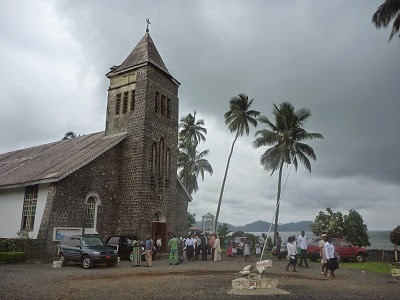
“I'm not sure we're going to make it to the church service after all,” I shrugged helplessly and gave Arnoldo a knowing nod as we surveyed the barely half-full minibus. Standing in the muddy car park on a Sunday morning, the two of us ignored the persistent pleas of the bus driver to climb into his minivan. The van would not leave until the seats were taken, aka. 'the bus don flop'. At the rate it was filling up, this could be a while. We were anxious to make it to Limbe to a Catholic mass by the seaside at one of the oldest missions in Cameroon, Bota Holy Trinity. 

Public transport is not always as speedy as one would hope.

“Douala?” a young man urgently shoved his inquiry toward us, anxious to take on another passenger. He pressed forward and tried to herd us like a pair of sheep toward his empty vehicle. 

“No, Limbe,” I refused his offer and scanned the car park again for any other vehicle that might be headed to the beach town sooner. 

The young scout slipped away, lost in the flesh of other anxious young drivers going to Limbe who'd suddenly heard their prompt. 

“Limbe, Limbe!” the man yelled excitedly. He ushered us toward his waiting 'clando' – a private taxi car that he will fill with four passengers in the back seat and two in the passenger seat up front before departing. These clando taxis can fill faster and are sometimes an expedited means of reaching one's desired destination. 

I looked dubiously at his vehicle. There was one elderly gentleman settled in the front seat. With Arnoldo and I, that would mean three more passengers before he'd go. 

I waited, not yet convinced at the drivers insistence, “We're going now, now, like this!” He was still searching for more customers as he proclaimed his imminent departure, waving his arms dramatically. 'Now' is a relative term.

The minutes ticked by and I looked at my watch. “Well, it might be that we are there just to see the church. The service might be over by the time we make it to Limbe,” I tried to look on the bright side. “It will still be an adventure.”

Suddenly the driver's tone ramped up a notch in urgency.  “Enter, enter,” he almost physically pushed us toward his clando. “See, ee de flop. We de go  now. Enter!”

Out of the periphery of my vision, I noted two well dressed women enter the car. The smaller woman was dressed in an cream-colored suit with matching hat – a very stylish hat trimmed with lace and angled jauntily on her head. It reminded me of photographs of certain  British royalty. The woman situated her purse in her lap and folded her hands over her small Bible. 

The other woman did some fast negotiations with the taxi driver and the elderly gentleman in the front seat. She was a much larger woman, actually. Amply cushioned as some might say. She was dressed in high-fashion too. She had on a tailored dress fashioned to accentuate her curves. The material was of the latest design and high-lighted with shiny gold accents. Her head wrapper added an additional six inches to her height. With the air of a queen, she situated herself unashamedly into the front seat while the small elderly gentleman happily stepped aside and moved himself to the back seat. She had that air of regal confidence. 

Recognizing that the taxi was indeed, now full, I gave a nod of agreement and climbed into the back seat of the car. Four in the back seat. We were cozy and ready for the drive to Limbe at last. As the elderly man squeezed his body and shifted toward the middle a bit more in an attempt to close his door, the elegant woman in front turned round to survey her company behind. 

“Ashia, Pa,” she gave the elderly farmer a gracious smile. 

“Thank you, mom,” he smiled up as he succeeded at least in getting the door to latch.

“I can't fit behind. Now I paid for two seats in front.” She smiled broadly. “I'm very comfortably situated now.”

Knees and elbows jabbing into each other in our cramped quarters in the rear of the car, all four of us nodded in agreement. Yes, she did seem comfortable in her front seat. 

Content that he now had a full vehicle, the driver kept quiet as he concentrated on the road. The incredibly green fields of the Tole tea bushes rushed past our window as he drove. A short quiet ensued as everyone sat ensconced in their own thoughts. Suddenly, the woman in the front seat turned slightly. “Today is Sunday. I want us to pray.”

“Amen,” her friend concurred. The elderly man nodded in agreement as well.

“Turn with me to the book of Numbers in the Holy Bible,” she began.

Of course, none of us could actually get out our Bibles and turn the pages given our incommodious quarters but this did not deter our front-seat preacher. 

 Confidently she dug into her purse and pulled out her small white, leather-bound Bible. She turned the pages and left them open on her lap. As she began to expound upon the story of the rebellious and ungrateful Israelites grumbling about wanting meat to eat, I wondered how she was going to turn this into a prayer.

“Now the people complained about their hardships in the hearing of the Lord,” she proclaimed, “Amen?!”

Her friend next to me murmured an agreeing “Amen.”

“...and when he heard them his anger was aroused...' “Praise the Lord?!” 

“Praise the Lord,” the elderly man reflected back. 

“'...Then fire from the Lord burned among them and consumed some of the outskirts of the camp...'” our taxi preacher was gaining steam, “Amen?!”

“Amen,” several passengers nodded.

Her exhortation continued at this enthusiastic fiery pace with loud exclamations soliciting the captive audience's participation. 

“'....Moses heard the people of every family wailing at the entrance to their tents.'”... Praise the Lord!” 

“Praise His Name,” we echoed.

“'... The Lord became exceedingly angry, and Moses was troubled.” Amen?!” 

“Amen,” even the taxi driver chimed in.

I still wondered where the spiritual lesson was going to be in her semonette. 

She continued on to verse 23 of Numbers chapter eleven, “The Lord answered Moses, “Is the Lord’s arm too short? Now you will see whether or not what I say will come true for you.”

“Amen?!” She breathed dramatically. 

“Amen,” the chorus echoed from her back-seat audience. 

Our eloquent taxi preacher tilted her head toward the driver. He kept his eyes on the road and gave her an affirming grunt of affirmation to continue. 

“Isn't God great?” she shouted in enthusiasm. 

“All the time,” we answered with a murmur of nodding heads.

“God is great. Amen?! From this passage we can see that whatever be the problem, God is able to deliver us. Praise the Lord! Amen! Here we see that God is telling Moses that He is not weak. He is mighty,” and her she paused for emphasis, “God is more than capable of delivering us from any problem that we might have – no matter the problem, whether it be financial problem, whether it be family problem, whether it be health problem, no matter  – whatever problem we might have, God is able to deliver us! Amen?!”

She paused to catch her breath, wiping a few beads of sweat that had formed on her forehead. 

“Amen?” She turned to partially face us seated behind her. “ No matter the problem; God is mighty and able to save us. Amen?”

“Amen,” we sighed in reply to her exuberance. 

“Isn't God good?”

“All the time,” everyone in the car answered.

“Amen,” she leaned back in her front seat and studied the words opened before her in her Bible. “We have nothing to fear. Just like God was able to deliver the Isrealites in the Bible, He is more than able to deliver us from whatever problem that we have.”

She folded her hands, satisfied. The verdant green vegetation of the tea plantation fields gradually transformed into the tumbledown wooden houses and dirt yards indicating that we were nearing Limbe.

“The Word of the Lord has spoken. Praise the Lord.”

“Amen,” we murmured in union. 

“Let us fold our hands and pray to our mighty Father in Heaven who is able to solve all our problems.” She raised her own right hand as she bowed her elegantly wrapped head. 

“Father in Heaven, we pray – we pray for your protection as we go to our various destinations. We pray, Father, we pray, that you watch over the driver and keep us safe as we travel. Keep us under your protection, we pray. We praise you that you remind us in the meditation today that you are our Deliverer. And, no matter the problem, you will deliver us.” 

She paused, head bowed, letting the words of her prayer sink in. “In your mighty Name we pray, Amen.”

“Amen,” the rest of the taxi raised their heads from joining her in prayer.


Arnoldo and I reached Limbe safely. We parted ways with our energetic taxi-pastor and her companion at the drop-off. The Catholic service was just beginning as we entered. I believe the sermon was about the Apostle Peter and the cornerstone of the church. It was a lovely picturesque setting for the church service. The waves rolled gently to and fro along the sandy shores. The salty sea breeze wafted through the rafters of the high vaulted ceiling. The choir's voices sang melodiously 
in the apse of the building. 


Two sermons in one Sunday morning. It was a blessed day.


“The Lord answered Moses, “Is the Lord’s arm too short? Now you will see whether or not what I say will come true for you.”  Numbers 11: 23


Wednesday, June 4, 2014

Universal Male Sporting Rituals


“Guys care about sports teams. I'm not talking about simply rooting; I'm talking about a relationship that guys develop, a commitment to a sport team that guys take way more seriously than, for example, wedding vows.”
― Dave Barry, Dave Barry's Complete Guide to Guys


I am not a ‘sporty’ person. I can count the number of sporting incidents like baseball games and American football matches that I’ve attended on one hand, I think. The last time I watched a football match was the world cup in 2010.

~o~

So they left the subject and played croquet, which is a very good game for people who are annoyed with one another, giving many opportunities for venting rancour.”
― Rose Macaulay

“There will be traditional wrestling up at the Pala-pala field today,” our Cameroonian friend informed us one Sunday.

“What time?”

“Four O’clock but you can come at five,” he replied.

“We should go.” I turned to Bill next to me. “Something different. Might be interesting for a while. I’ve never seen traditional Cameroonian wrestling.”

So the three of us found ourselves up at the Pala-pala field that Sunday. Curiosity about the sport took precedence over my usual reservations on watching male testosterone-touting athletic feats.

The wrestling field is a natural amphitheatre. The grassy slopes surround a more or less level circular playing arena below. Wooden pickets with white crosshatches that have the village name painted on them and look like the white crosses of marking graves dotted the edges of the field. Villages grouped themselves accordingly to show support for their wrestling representatives. A gigantic oak-like tree that appeared as if it had had witnessed many hundreds of events on the field loftily stretched its thick branches over the upper corner of open expanse. Perched on the wooden supports fastened to the tree’s branches were three enthusiastic ‘sport’s announcers’. They pounded tirelessly on their traditional drums in an upbeat, intoxicating rhythm that added spice and vibrancy to the atmosphere of expectation that permeated the jostling, talking crowds. Women and children wove through with snacks balanced perfectly on their heads – peanuts, chin-chin, plantain chips, fruit slices. The perfect sport’s event – crowds, sweat, shouts, laughter, music, and food.

“One, two, three…” the referee counted down on his fingers and on the count of three the two young boys hunched over and eyed their opponent. They looked to be about ten years. Small. Sturdy. Muscular. Slender.  Apparently the young boys start before the adults kick-off the game officially. The two young boys waved their arms over their head in a pawing manner as if they were getting ready to pounce on their prey. They concentrated on every move their opponent made trying to anticipate and outmanoeuvre. As they each reached forward toward the other, they circled within the confines of the white wrestling circle.

“The goal is to get the other person on their back,” our Cameroonian friend leaned over and informed Bill and I. “As soon as the back of one touches the ground, the other person wins.”

One of the boys lunged forward. His opponent skipped sideways and dodged the outstretched arms of the other. They circled around each other for another round. Suddenly, the shorter of the two reached out and caught the shoulders of the other. Instantly, the two locked into battle. Muscles bulged and ligaments strained. The boys danced left, right, and all around each leveraging to get the other one to fall over. The grimaces on their small faces matched the effort they were expending to try and win this match.


“Do they have to hold their opponent on the ground for three seconds in order to win?”

“No, any touch of the back to the ground constitutes a win for the other person.”

I watched as the two boys used all their strength to try and unbalance their opponent and get him to flip over. Each crouched low and kept a wide stance. They were equally matched.

The referee blew his whistle. One of the boys had pushed the other outside the white line. Instantly the boys regrouped in the middle and returned to a their former locked-limb configuration. One boy stumbled and almost fell. The crowd cheered and shouted. The referee’s helper in a red-knit hat watched the boys closely for any sign of foul play.

“What are they doing over there?” I turned to my friend and indicated a group of young men kneeling on the ground in front of a table under a canopy. The young men with traditional cloth wrappers knotted around their loins formed a semi-organised half-circle in front of the elderly gentleman writing names down on a sheet of paper.

“They’re registering their names for the match,” he answered. “They have to show their respect by bowing before their elders when they ask to participate in the wrestling.”


“Oh,” I said. Now that is something different from American sports events that I’ve attended. Respectfully kneeling before one’s elders/leaders. Not a bad concept. It was interesting to watch these same young men, after paying their respects to the presiding elder, later mingle in their groups. They were otherwise your typical free-spirited young male species boasting big male egos, loud laughter, beer, and cigarettes – not to mention the sagging jeans that always look as if they’re going to fall off and give a full view of the underlying colourful boxers/underwear.


“Any game becomes important when you know and love the players.”
― W.P. Kinsella, Shoeless Joe


As the men registered, the young women did what young women typically do at athletic events. They strutted and giggled. High-heels, sparkling dresses, and flirting laughter punctuated the crowd as the ladies threaded their way among the crowds in pairs of two or three – sometimes five or six. Male and female eyed each other from a distance. Yes, I thought, a rather universal activity at sporting events – testosterone meets oestrogen.

I turned my attention back to the youngsters in the ring. Each boy fought with all his might. A fierce determination registered on each of the their faces. Back and forth they gyrated locked in their wrestling. The drummers thumped out an encouraging beat. The crowds cheered. Eventually, the one boy was momentarily thrust off balance so that his left shoulder touched the muddy surface. The whistle blew. The other boy had won.

A group of mature women in matching cabas danced enthusiastically onto the field and trampled all across the boundaries of the wrestling circle. The referee blew his whistle and waved his arms to redirect them elsewhere in vain. He was absolutely hopeless in his efforts against these solid and joyful dancing women. No itty-bitty young pom-pom waving cheerleaders here. Mothers and grandmothers of solid-build and genuine enthusiasm danced a congratulatory, winner’s dance for the boy. A man, perhaps a coach, with greying hairs and strong muscles, rushed out and hoisted the winning boy onto his shoulders. The boy punched the air with a big smile on his face.

People cheered. The women yodelled. It was a big moment for the small boy. All around the field, the papa figure carried him. Clearly, he was proud of the child as he raised his own hands in a gesture to generate more cheers and clapping from the crowds. The younger men in his village that had registered to wrestle in the match gave the kid high-fives and backslaps. Some of them, in their excitement over the win, gave each other hugs and chest thumps. Very male bonding-ish. The same behaviour is observed everywhere among the masculine species at sport events.  I smiled. The enthusiasm was infectious. It was very uplifting to see a village come out and show such sincere support.

And what about the boy that lost? He was picked up by his village papa and given a big hug. Although he didn’t get a winner’s congratulatory stroll around the field, he was walked back to his waiting teammates with a comforting hand supporting his shoulder ensuring him that he was still part of the team and his mates were not disappointed in him. He pulled up his traditional cloth wrapper around his waist and strutted back with his chin up – perhaps a little disappointed he hadn’t won but not discouraged. Next time… One could see it in his posture and face. He was a determined chap.

In the dust of defeat as well as the laurels of victory there is a glory to be found if one has done his best.”

― Eric Liddell


The adult-version of the traditional wrestling was much the same as the kids. Suddenly an extra-excited hum of chatter filtered round the watching fans.

“The white-man is up next,” my friend answered my unspoken question.

I strained on tiptoe to see. A very white man with an even paler white chest strolled out to the middle of the wrestling circle, Cameroon wrapper around his waist and all. His opponent was a very black Cameroonian. They appeared to be about the same size – same height and general build.

The two opponents faced each other and shook hands. The referee checked their mouth and hands for any foreign objects. Satisfied, he blew his whistle. Black and white men circled and quickly locked arms.

“How long do you think he’ll last?” I asked my husband, referring to the white volunteer.

“Not long,” he answered knowingly. My husband had once tried to toss a small five-year old boy up in his arms at the orphanage during playtime. The boy was slender and appeared lightweight. Not at all! My husband almost sprained his back! The youngster was solid muscle. Much heavier than he looked.

My husband’s predictions were barely out of his mouth before the white man’s opponent lifted him up and almost gently flipped him onto his back. Oh well… kudos to the white guy for trying. The crowds cheered and laughed. No one really lost on this match. The Cameroonian proved his strength and the foreigner had an unforgettable experience. Everyone was happy.

Cultural curiosity satisfied I headed home as the sun was setting. “Interesting,” I commented to Bill. “It seems to be rather universal that at sporting events there is an unspoken code of manly display. Enthusiasm, joy, mutual encouragement is shown through certain physical bonding rituals rarely witnessed any other time – hugging, chest thumping, fist pumping, back slapping, and high-fives. Perhaps it is part of the global language of testosterone brought about by the atmosphere of adrenaline-charged sporting competitions?

~o~

“It seems that soccer tournaments create those relationships: people gathered together in pubs and living rooms, a whole country suddenly caring about the same event. A World Cup is the sort of common project that otherwise barely exists in modern societies.”

― Simon Kuper, Soccernomics: Why England Loses, Why Germany and Brazil Win, and Why the U.S., Japan, Australia, Turkey--and Even Iraq--Are Destined to Become the Kings of the World's Most Popular Sport