Showing posts with label Patients. Show all posts

Wednesday, April 15, 2015

The Elusive Magical Fairy Wand


“Reputation is what others think of us; character is what God knows of us.”
― Shannon L. Alder


Let’s face it, if medical professionals depended on the fickle fancies of their client-patients’ enthusiastic affirmations of ‘job well done’, we’d be in trouble.

Even theoretically, few would claim it’s possible to satisfy every customer, every time. People are fallible human beings with wishy-washy whims. Most of the time we don’t even know what we want. In an age of instant gratification with expectations of continual entertainment, it’s simply not possible to meet the standards. Healthy, happy people are often disappointed. How much more difficult it is to satisfy sick clients in mental and physical pain?

Perhaps if doctors had magical wands that they could wave in a graceful arc with cascading, twinkling fairy-dust floating down over the sick patient and instantly erasing all illness…  Unfortunately, I haven’t come across such a wand. However, if anyone does, please let me know!

So, it is not easy working with people who are suffering every day. I like to see people smile. I like to cheer people up. Generally speaking, I chose a profession in medicine because I wanted to make a positive difference in the world. Without my magical fairy wand though, I seem to encounter an awful lot of disgruntled, unhappy sick people.

Madam X sat across from me with a frown and crossed her arms. “Doctor, I’m sure there’s something wrong. I’ve gained 10 pounds and I haven’t changed anything in my life. I’ve never been this heavy before. I do the same things. I haven’t changed my diet. There’s something wrong with my thyroid.”

I glanced at her recent blood work on the computer and tilted the screen for her to view the results. “Your thyroid test was normal last month,” I reassured.

“That test isn’t always accurate though, doctor. I know there are other tests to check my thyroid that are better.” Madam X leaned back and stared defiantly at the normal lab results.

“Umm, this blood test for thyroid problems is very accurate.”

“I had a friend who’s test was normal but then her doctor ordered some other thyroid testing and they found out she had low hormone levels.” Madam X scowled. “Doctor, there is something wrong. This weight is not normal for me.”

“All your recent blood work is normal. Sometimes as we get older, our metabolism slows down a bit and it’s easier to put on weight. Diet and exercise are still the best ways to control weight and stay healthy.”

Mrs X shifted in her chair. She was clearly not convinced. “Doctor, there’s something wrong in my body that is making me gain weight.”

I shrugged. “I’m sorry. I know it’s not easy. We can talk about some ways to improve your diet and increase your activity. There are classes and groups you can join. I can suggest some local gyms.”

“No, I’m not interested,” Madam X replied. Her tone was increasingly becoming more frustrated with the way things were going. “I know how to eat and I already walk enough at work. There’s something else wrong inside my body. You’re just not willing to order the right tests.”

She left angry and frustrated. “I’m just going to have to find help elsewhere,” she gave me a pointed glare as she packed up her purse and put on her coat.

Clearly, not a happy customer.

Madam Y dangled her legs at the end of the exam bed while she fidgeted with the elaborate beaded necklace that hung round her neck. “What a beautiful necklace,” I exclaimed as I shifted our consult from the initial verbal history of the problem to the physical exam portion. Her earrings were beaded in a matching pattern with her necklace.

“Thank you, doctor,” she turned her head for me to examine the opposite ear. “My daughter makes them.”

“You have a talented daughter, very artistic,” I added.

She nodded in agreement while I listened to her heart.

“Does it pain anywhere where I press?” I asked while I palpated her abdomen to ascertain spleen and liver size.

“Right there,” she indicated as I put pressure over the lower portion of her stomach, below her umbilicus.

“Oh?” I hadn’t expected a positive to my query, having already gone through a review of problems:  high blood pressure, migraines, and sinus allergies. I felt my pulse do a double skip. Pain in the stomach can be a bottomless pit of inquiry (pun intended). A million different things can cause stomach complaints, everything from benign indigestion to life-threatening colon cancer.

“Yes, doctor, sometimes I get this annoying pain, not really painful but, well, sort of uncomfortable down where you were pressing.” She sat up as I finished poking around on her belly, having ensured there were no big masses or obvious fibroids.

I waited for her to continue.

She shrugged with a noncommittal smile. “It’s probably nothing, doctor, but I just worry, you know. It’s nothing new. Just every now and then. I keep forgetting to mention it to the doctor when I have my appointments.”

I nodded.

“Probably has more to do with when I eat too much or have too many sweets.” She folded her hands and gave an embarrassed laugh. “I know it’s not good for me but when I go out to eat. I always have dessert.”

I went throw my list of ‘red flags’ -- danger symptoms that could indicate a patient has some perilous medical condition potentially going on in their bowels. Madam Y thankfully didn’t have any of them.

“I can’t find anything on the exam or in the symptoms that you’re having that indicate we need to do more testing. From what you’re telling me, there are no signs that anything like a nasty cancer is causing the stomach pains.” I mentally reviewed my internal checklist and again came up negative for anything concerning. “You might want to keep a symptom diary and jot down when the pains come and see if there are any particular situations or foods or patterns to the pain.”

She was quiet.

I waited for her to disagree with my predictions and recommendations.

Madam Y looked down at her slightly protruding abdominal fat roll. With a wry grin she let out a sigh. “You’re right, doctor, I really just need to eat better. I eat too much. I don’t like the added weight. I’ve sort of ignored it but I know I should be more active at the gym and cut down on my calories.”

“Choosing more healthy foods and getting more exercise is always a good idea,” I encouraged Madam Y with her inner health resolutions. “Exercise is the best medicine. It’s the closest thing there is to a panacea. It’ll help the weight and your blood pressure and reduce your risk of diabetes later on in life. Exercise is good for digestion too. I bet it will reduce the stomach pains.”

Madam Y nodded resolutely. “You’re right.”

I have never considered myself to be a great cheerleader. No pom-poms or fireworks. I smiled and nodded my affirmation then closed out her visit and went to print off her the summary. As I rose to exit she suddenly stood up. “Oh, doctor,” she exclaimed with a huge smile, “thank you so much. I just love you!” She rushed over and enveloped me in an unexpected hug.

My eyebrows nearly jumped off my face in surprise! (Thankfully, they are still attached. I checked afterward.) To say I was shocked is an understatement. I was certainly caught off guard. Not the reaction I was expecting. I’m not complaining either, mind you.

“You’re welcome,” I stammered back in response as she released her hold of me.  

Clearly, she was a happy customer.

Happy and satisfied versus frustrated and angry. I really can’t take credit for either reaction. There are too many other variables within a person’s life that affect the outcome in our clinic visits.

Madam X and Madam Y, with their contrasting attitudes, are a reminder that satisfaction comes from within. It’s a mind-set that we choose. I cannot look to customer satisfaction surveys or patients’ words of affirmation. Medicine is fraught with sickness, suffering, and people with emotional and physical pain. The courage to carry on in the midst of it all comes from outside my work.

I work for Christ, and, well, He’s already given me His stamp of approval.


1 Peter 4:11

Do you have the gift of speaking? Then speak as though God himself were speaking through you. Do you have the gift of helping others? Do it with all the strength and energy that God supplies. Then everything you do will bring glory to God through Jesus Christ. All glory and power to him forever and ever! Amen

Wednesday, February 18, 2015

The Foot Mystery


A/N: Not everything is as it appears at first glance, sometimes you have to dig deeper...


She was in her early forties, a tad overweight due to a penchant for that extra bite of chocolate or cookie that invariably sneaks into the office where those of the female gender congregate.  Her smile was infectious though and her easy-going manner lightened the atmosphere in the examination room as I settled onto the doctor’s stool at the computer screen.

“Good afternoon, Mrs H**,  my nurse tells me you’ve been having a boil on your foot recently,” I looked over at her and then down at her right foot.

She nodded in affirmation to my query.

“She also mentioned that you’ve recently taken some medication for it but it’s still not going away?”
Mrs H again nodded. “I just finished the antibiotic. Some of the redness has disappeared but it still pains and the swelling doesn’t seem to be getting any better.”

I glanced over the urgent care note from a few days ago. ‘Diabetic foot wound’. Ah, so Mrs H had diabetes. I wondered how well controlled her blood sugars were. Perhaps the foot wasn’t healing because her blood sugars were too high or she had some sort of circulation impairment in her feet? “Are you taking your diabetes medicine?”

“Yes,” she answered, and then added, “my sugars are always good too, 90s to 100 when I check them.”

“Excellent!” I praised. I noted in her electronic chart that her last haemoglobin A1c (a measure of how well her diabetes was under control) was 6.8 – collaborating with her reported fasting blood sugar readings. My theory about a non-healing foot wound due to poor control of diabetes disappeared. Poof! Gone. Time to figure out another reason that her foot wasn’t getting better.

“Are you having any fevers?”

“No,” she shook her head.

“How did this boil on your foot begin?”

“Well,” she began with an embarrassed shrug. “A couple weeks ago I got angry at my husband and kicked the door. I noticed pain in my foot and later it got all red and swelled up. A boil developed on my foot and then sort of burst when I pressed it. Pus came out. That’s when I went to the urgent care doctor and they gave me the antibiotic for the infection.”

“Ah,” I typed a few notes down in the computer. “So this all began a few weeks ago and the antibiotic helped but didn’t completely clear up the infection?”

Mrs H looked down at her sockless feet resting on the blue paper as if for confirmation of the fact. Noting the swelling on her right foot, she nodded in agreement with my summary.

Internally I summed up my understanding of the situation with Mrs H. Diabetes. Abscess on foot. Took antibiotics. Not better. Still painful too. Hum?

“Well, Mrs H, if it’s ok with you, I’ll take a look at your foot?”

She affirmed her consent with a nod. “It hurts here.” She leaned over from her seated position and indicated the top portion of her right foot.

“Ow!” she drew back when I pressed over the bones in her foot. I wondered if she might have fractured a bone when she kicked the door.

“Did they take x-rays of your foot last week when you went to the Urgent Care?”

“Yes, they said everything was fine. The bones were not broken,” she reassured me.

I continued to palpate around the small swollen area on the top of her foot. The good news – there wasn’t a lot of redness so the antibiotics had apparently done their job in eliminating the irksome bacteria. The bad news – there was still obviously a swollen small lump and pain on the foot.

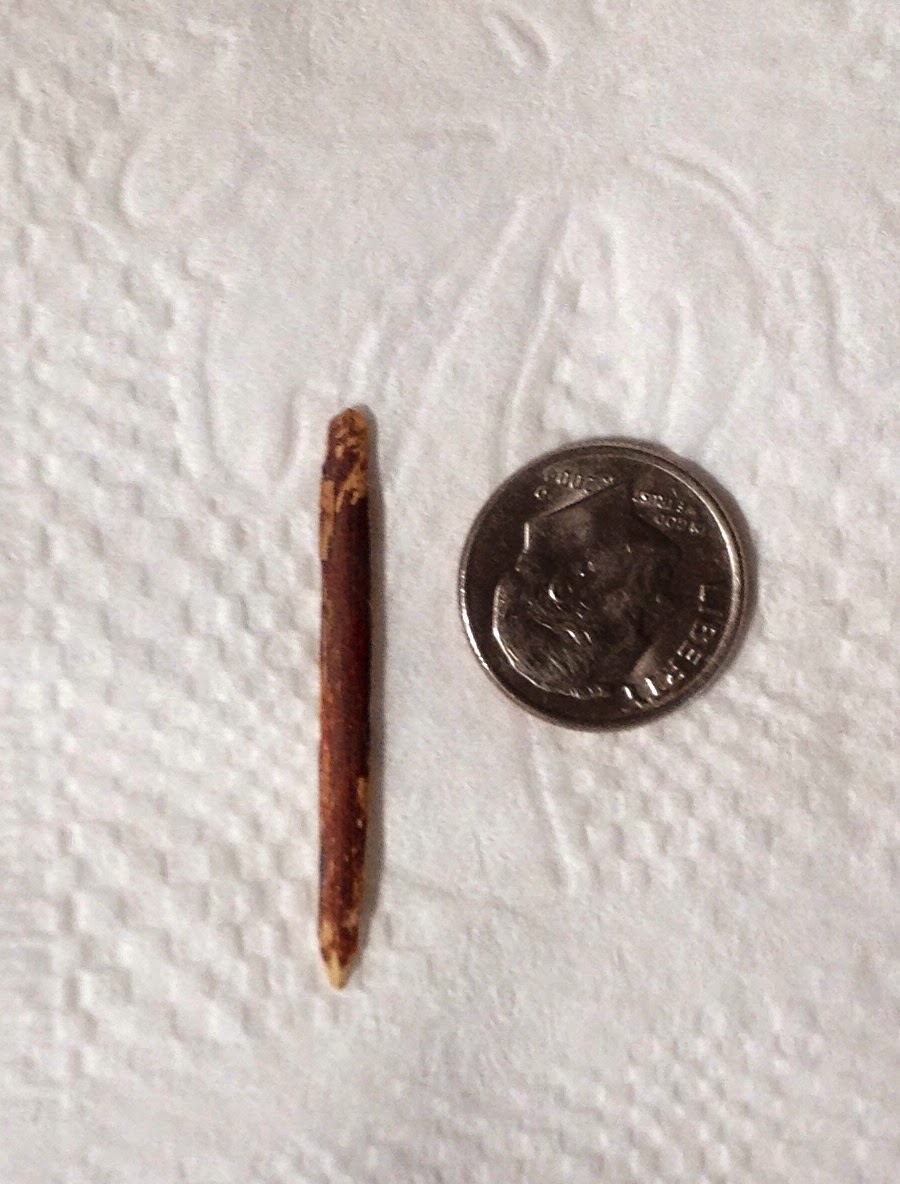
“It feels like there’s something under the skin where you have the boil,” I looked up at Mrs H. “Any chance you might have caught a splinter when you foot hit the door?”

Mrs H thought for a moment and shook her head. “No,” she paused and then her face lit up, “my mom pulled a splinter out of my foot when I was a child.”

“Oh, what happened?”

“My brother and I were jumping on the bed. My foot got cut on the bedpost when it hit it as I fell. I told my mom there was something stuck in my foot. She said she pried out a piece of wood when she bandaged my foot.”

“Interesting,” I tried to figure out how a story of falling off the bed at the age of five related to her current problem of foot pain forty years later.

“You know, doctor, this foot has always acted up. I used to tell my mom that I thought there was still a splinter in my foot but she could never find anything when she poked around.”

“Oh?” Apparently there was more to the history with her foot than I’d originally assumed.

“Yes, doctor, my right foot has always been prone to getting a boils.”

“So this isn’t the first time you’ve had an abscess on this foot?” the light was beginning to dawn on my consciousness.

“Now that you mention it, I had something like this last year too.”

“And you’ve been seen at the doctor’s office before for this abscess and they’ve never found anything?”

“I just take the medication and it seems to go away but never completely. I get pains in the foot on and off. I have to wear shoes with socks because I can’t stand for the straps from sandals or slippers to rub on the top of my foot.”

The story was becoming more complicated. More than a one time infected skin abscess. “Do you mind if I numb up this area on your foot and see if there’s anything I can find? It feels like there’s something like a splinter or toothpick in your foot.”

Mrs H agreed to my exploratory mini operation. After numbing the area with local anaesthetic, I nicked the skin over the strange solid thing that I’d felt on my exam. If nothing showed up on x-ray, it must be something organic stuck in the foot. With a fine forceps I dug into the tissue and snagged the object I’d felt.

“It looks like you’ve been keeping half a toothpick in your foot,” I pronounced to Mrs H with a triumphant smile. I held out the forceps that now grasped almost an inch long wooden splinter extracted from her foot.

Mrs H adjusted her glasses and leaned forward for a closer examination.

“It looks like you were correct. You did still have a piece of that bedpost in your foot. You want to take it to show your mom that you were right?”

Mrs H laughed. “After all these years…”

“You’re foot should heal up properly now. Without that piece of wood irritating the tissue, you shouldn’t have any more problems.”

“Wow, doctor. That’s great.” She continued to smile, still somewhat in shock, I think. She had me put the wood in a plastic wrapper for her; and in fact, did take it home. I can only imagine what she told her family.

Moral:
1.     Things are not always as simple as they might appear at the onset of a clinical situation
2.     Don’t try to keep a splinter in your body for years – it festers!


“Why do you see the speck that is in your brother’s eye, but do not notice the log that is in your own eye? Or how can you say to your brother, ‘Let me take the speck out of your eye,’ when there is the log in your own eye? You hypocrite, first take the log out of your own eye, and then you will see clearly to take the speck out of your brother’s eye.” Matthew 7:3-5


“As you slide down the banister of life, may the splinters never point the wrong way.” –Irish Proverb


**All identifying data including specific circumstances altered to protect identity.

Friday, June 20, 2014

A Fitting Diagnosis


(Names and details changed for privacy)


“Doc, will you see this man tomorrow?” Nurse Kay gave me a very beseeching smile. “Please.”

“You know I normally avoid non-emergency consultation on Saturday, Kay,” I replied, unconvinced.

“But doctor, he was really disturbing me when you had to go out,” Nurse Kay grimaced as she shook her braids at the memory. “I thought he was going to bite my head off.” Her gesture conveyed a genuine sense of pain regarding the recent encounter.

“Really?”

“Yes, doctor,” she added in earnest. “I really had to talk to him a lot to get him to calm down. I promised him that you would see him tomorrow at eight o’clock.”

I realised this Friday had taken its toll on everyone’s patience, including my own. Complications and emergencies in the hospital ward, unplanned procedures, a funeral to pay homage to a fallen colleague in the medical field – the day had been a blur of activity. The frustrated, impatient frowns from the outpatient clients in the waiting room had not escaped my notice earlier.

Sensing my weakening resolve, Nurse Kay pressed home her supplication. “Please, doctor, I told him to be here promptly at eight o’clock.”

“You know I have church on Saturday, though.”

“ I told him that. He said he would be here at eight. I told him if he came late you would be gone to church.”

Nurse Kay knew she’d won her case. I sighed. “I already took the history and everything for you, doc.” She smiled with a triumphant grin and handed me the patient’s book.

I opened the green paperback notebook and peeked at the chief complaint.  I wondered what dire emergency had made this man angry when he wasn’t attended to in the clinic so promptly. I hoped that if he was seriously sick he would have consented to admission after a brief consult with our competent nursing staff. Thankfully, his vital signs were normal. He was 32 years old, I noticed. I shook my head. It usually takes a lot for an otherwise healthy adult male to see a doctor.

The next morning, Saturday, I walked over to the hospital to check on the inpatients. As expected, anytime I am in the hospital, other clients find me and I found myself completely occupied until 9:30 am. I forgot that I hadn’t even seen the mysterious impatient patient from Friday. By the time I remembered, I was already in church. I had certainly given him ample time to make it to his special appointment by 8 am. I had been around until 9:30. Perhaps he’d gone on to another hospital given the urgency of his demands?

Monday came round. Mondays have a bad habit of appearing every seven days, it seems…. Anyway, the client numbers in the outpatient clinic were above 30, so, much to half the folk’s dismay, some waited quite a while to see the doctor. At the end of the day, I noticed a familiar green medical booklet in my shelf.

“I called his name several times today,” I explained to Nurse Kay. “What happened?”

“He left, doc,” Nurse Kay shrugged. “He said he couldn’t wait.”

“He was only the second patient in line to be seen today though,” I countered. “Besides, I waited for him in the hospital on Saturday and he never showed.”

Sigh.

Tuesday came. I was hurrying to open up the clinic and get morning worship going. Several clients milled around the front door, waiting for our outpatient services to get started for the day.

“Doctor, I want to see you,” a young gentleman pressed forward as I stepped up on the porch to unlock the door.

“No problem,” I gave my automatic reply. “I will see you after we have our morning staff worship. You are welcome to join us.”

“But, doctor, I’ve been waiting. I want to see you now.”

I tried to take a step back as this gentleman was rather cramming into my personal space. (I’m not one to need a huge bubble either). I held up my hand in an attempt to keep us from bumping noses. “After worship, I will start my consults.” He was clearly not dying or in any visible pain. There was nothing externally wrong with him that gave any indication he needed to be seen more urgently in the hospital and be admitted.

“But, doctor, I’ve already paid to see you.”

“And I will see you – after worship,” I re-stated firmly. I gathered up the worship hymnals and passed them out. “Here, have a book,” I indicated a place on the bench for him to sit while I held out a book of hymns. The other staff and patients were thumbing through the pages, searching for a familiar melody. Assessing the situation, he grudgingly settled down.

~o~

“Mr. Johnson,” I looked at the now recognizable green book and name. So, he was back – again.

“Coming,” a familiar gentleman rose from the waiting room bench, pocketing his mobile phone. The gears clicked. The less-than-patient gentleman of the morning was none other than the mysterious missing patient from Friday. Interesting.

I sat down at my consult table and read over Nurse Kay’s detailed history of his main reason for consulting. Mr Johnson settled in the chair opposite.

“Doctor, I’m tired,” he frowned and turned his palms upward with a dramatic sigh. “I have a lot of responsibilities. I can’t wait.”

“Ashia,” I let him continue.

“Thank you, doctor,” he automatically replied. “Doctor, I came here on Friday and you were not. They told me you were at a funeral.”

I nodded in confirmation.

“I couldn’t wait until you came back.”

“I looked for you on Saturday,” I replied. “I waited for you until I went to church.”

“I came, doc, and you were not,” he insisted.

“Didn’t the nurse tell you to come at 8 am?”

“Yes, but doctor, you were not.”

“I waited for you until I went to church at 9:30 am.”

“But, doc, I came.”

“You came after I’d already left for church.”

He conceded the fact with a nod. “But, doc, when I came you were not.”

“I was at church.” Since church is generally considered a legitimate reason to abscond from the hospital, I knew Mr Johnson had little recourse to argue now. As I expected, my pronouncement silenced his complaints for a few moments.

“I’m here now,” I attempted to clear away the past and re-focus our meeting on the present. I gave him my full attention. “Now tell me about your problem. What brought you here to consult?”

Mr Johnson gathered his thoughts for a few moments and let them sort. He took a breath and released it slowly. Then he began. “Doctor, my girlfriend,” he paused, “my girlfriend’s not happy. When we make love my stamina is not too strong. I weaken too fast.”

“You mean that when you have an erection, you climax too quickly?” I clarified.

He nodded.

Diagnosis: Premature Ejaculation

Rather fitting, given the circumstances?

 ~o~

“We can rejoice, too, when we run into problems and trials, for we know that they are good for us—they help us learn to be patient. And patience develops strength of character in us and helps us trust God more each time we use it until finally our hope and faith are strong and steady.”

Romans 5:3,4


Saturday, September 29, 2012

A Shocking Experience


The book said, “For cutting on the skin, or the shave technique noted previously, usually an intensity of 2(20W or less) is sufficient…rarely over 4(40W).

Part of the problem with being the only physician here at our Seventh-day Adventist hospital is that the handling of every piece of hospital equipment is left to my meager database of medical equipment mechanics. I freely admit that the inner workings of machines are not my forte! I enjoy the study of the body, the flow of blood through arteries and veins, the helper T-cell defense against an onslaught of foreign invaders, or the wheeze generated from constricted asthmatic lungs. However, put a fetal monitor, an autoclave, an oxygen concentrator, or an electro-cautery in front of me and my brain goes numb and freezes up. Have you ever tried reading the manual for an autoclave? Let’s just say, if you’re suffering from insomnia…

One evening not so long ago, I was attempting to come to terms with the intricacies of the electrosurgical unit (ESU). I’ve used similar machines to cauterize skin lesions before but never had to set one up, program it, and maintain it.  In residency training I was used to working with a team of supporting personnel. In retrospect, maybe the ‘team approach’ was not so helpful. I certainly didn’t learn the finer points about operating medical equipment.

The reason for my studious labors was related to the birth of a little baby girl born the day prior in our labor and delivery unit. She had a miniature sixth finger on her hand. Really it was more like a lump on her pinky finger that was attached with a thin curtain of skin. I could have tied a string around it and let it fall off; but then, where’s the learning opportunity? Over the past few months I’ve conquered the autoclave (really, the hospital is still standing and we haven’t had any fires!), read through two oxygen concentrator manuals, and blundered through tocometers and fetal heart monitors on pregnant mommies. It was time to tackle the ESU.

I sat on the cool, white tiled, floor in the theater with our electro-surgical unit innocently resting on a metal roller cart. After a bit of searching, I found the grounding pad, a metal plate, and the electrode tip with a hand piece that looked like a pencil with two buttons.

“First things first,” I said out loud to no one in particular. The theater was empty. The lights and bed didn’t mind my ramblings. “So, what’s the voltage on this machine?” Turning the unit around I found the tiny red switch that alternated the machine from 110 to 220 voltages.

“OK. Here it goes. Hope it’s correct.” I crossed my fingers and plugged the unit into the socket. No smoke, loud pops or other heart-accelerating noises!

I pressed the button on the front that looked like the on/off switch. Nothing. “Hmm. What’s happening? No electricity from the socket? Broken machine? Something else I’m forgetting?” All were highly probable.

I crawled around the machine and looked for additional switches and finally found a potential candidate on the rear. I flipped it and pressed the front button again. Yea! Familiar beeps, buzzes, and lights flicked on.

Luckily, the grounding pad and the electrode only fit into unique slots on the machine. I plugged them into their respective places.

“Now, how to operate this thing?” I figured it was probably a good idea to know how control the machine before trying it out on a patient.

I poured over the textbook again. Under the heading, “Skin Tags”, it listed the power setting as 3/25-30. So which was it? Three or thirty?

I really didn’t want to practice on the little baby girl. I confess, that yes, I didn’t want to cause any more pain than absolutely necessary; but, I also had a bit of professional pride and didn’t want to look inept in front of the family member.

Now, there may be a few readers who are wondering. Why not practice on a piece of meat like a chicken breast? That would be a perfectly reasonable solution. However, I hate waiting. I didn’t have the patience to put things off until the morning when the meat could be obtained from the market.

Impatience and pride – never a complimentary combination! I found the nearest suitable practice material, my arm. Now, just in case you’re getting worried, relax, this story has a happy ending! I just figured this would be a fast, easy way to figure out if the settings were in units of 1 to 10 or 10 to 100.

I turned the settings to 1. The lowest. “Um. Is this working?”

I upped it to 2. “Can’t feel anything. Is there electricity conducting to the hand piece?” I adjusted the grounding pad and checked the wire connections. Everything seemed to be in working order.

I continued to 3. “Maybe this uses units of 10?”

Getting a bit anxious and curious to see if the machine actually worked, I ramped the power setting to 10W.  At last I thought I felt a tingle of electricity.

At 20W I was sure that the ESU was working. The power didn’t seem particularly effective though. Suddenly another worry popped into my consciousness. Would 30W be enough to cut smoothly through the tissue?

On occasion my curiosity gets the better of my common sense. This was probably one of those times. At 30W the electrical spark was very apparent! Despite using the fine needle tipped electrode, I had a neat little red spot on my arm. At least my curiosity was satisfied!

The reader will be relieved to learn that the baby girl with the extra digit on her hand is doing great! I expertly sliced it off in less than a second with hardly a whimper on her part. My arm is fine. The red spot faded after a few days. Not only that, but now I can say I’m on friendly terms with the ESU. We’ve had a wonderful working relationship this week with additional cases. There’s just a few minor details to work out…

“The end of a matter is better than its beginning, and patience is better than pride.” Ecclesiastes 7:8

Friday, June 29, 2012

Eclampsia!


The Crew: father, mother, baby, doctor, nurse, and mother-in-law

Loud cries and wails rose in crescendo, marking distress and disaster more clearly than any siren, and accosting my ears as I suddenly became distracted from Prosper’s worship remarks during our morning staff devotional.

“Doctor, come quick!” Helen gasped, out of breath from her dash across the yard and now poking her head through the front door of the clinic. Her normally placid expression was replaced with one of anxiety and trepidation. A sense of urgency uncharacteristic of our usually stoic, unflappable cleaner and medical assistant pervaded her features.

Several staff members immediately rushed out and ran over to the hospital to assess the emergency. “I’m coming!” I call after their receding forms.

I know that Christiane, our head nurse, will begin the assessment of the problem without difficulty. I need a moment to seek strength and wisdom, courage and a clear mind, from the Source above. I am fairly certain that I’ll be engulfed in a complex medical emergency in just a few minutes. An extra sixty seconds of prayer is worth far more than those few seconds spent rushing ahead full of anxious, disarrayed thoughts.

Prosper bowed his head and gave what is probably his shortest closing prayer yet! The other outpatient clients, who looked rather wide-eyed and stunned, joined us in prayer.

With the final Amen, I stood up and took a slow, deep breath to calm myself before the storm brewing in my immediate future inside the hospital.

Several fear-filled relatives came spewing out of the hospital front entrance, wailing with loud lamentations, wringing hands, and holding their heads in a gesture of unbearable emotional distress.

Making it through this gauntlet of wailing human bodies, I entered the maternity ward where our very first antenatal patient had delivered a healthy baby girl the evening before. There had been no complications. Everything up to this point had been perfectly ordinary.

The scene that met my eyes seemed surreal, like a bad dream. Visiting family members, dressed in colorful traditional wrappers and headscarves, agitated in futile circles of arm waving and crying. They were full of fear but powerless to do anything. A palpable atmosphere of panic filled the room and mixed with the aroma of traditional Cameroonian food and hospital antiseptic. Large plastic coolers were clustered on the floor along with plates, bowels, and other utensils that lay in untidy piles. Suitcases that were open and overflowing with clothes, linens, blankets, and other personal toiletry items decorated the empty patient beds. There was enough stuff in the ward to appear as if an army of Africans had moved permanently into the hospital! Disguised amongst all the belongings, against the far wall, stood the plastic bassinet with a contented, sleeping baby girl cocooned snugly under layers of warm blankets.

Pressing through this chaotic mass of wailing flesh, I found our patient convulsing in bed while her terrified husband cradled her limp head in his arms. Her eyes were rolled back in her head unconscious of the drama around her. A trickle of spittle flowed down the side of her cheek from the frothing secretions bubbling from her mouth and causing her to emit eerie rasping breaths.

Oh! Doctor! Ooooooohhhh….” Rosie’s mother in law grabbed my arm in desperation.

“Everyone, out!” I shouted. “Out, out, out!”

I felt like Jesus as he dismissed the wailing crowd from the dead girl’s room. (Mark 5:39,40)

I carefully unlatched the mother-in-law’s fingers from my upper arm and reached the bedside.  Christiane was at the head of the bed and Noela was at the foot.

“You know what she has?” I queried my nurses as we rolled Rosie on her side.

“Preeclampsia?” Christiane replied hesitantly.

“Very good,” I encouraged her. “Actually now she has eclampsia since she had a seizure but, yes, it began as pre-eclampsia.”

The nurses and husband finished getting her in a proper position. Then I shooed the husband and mother-in-law out the door.

“Noela, get the oxygen.” She scampered off to get the oxygen concentrator machine. Thankfully, I’d just checked it yesterday and attached new tubing so it was ready to go.

“Christiane, get an ampoule of diazepam and give it to her I.V.” She nodded and went off to get the medication and needle.

I took the blood pressure cuff and wrapped it around Rosie’s arm. 160 over 101 mmHg it read.

I listened to her heart and lungs and checked her pupils and capillary refill. Other than an elevated blood pressure, her vital signs were normal. She had a little swelling in her legs but otherwise her physical exam was average too.  My heart calmed down a little.

Noela returned with the oxygen and we positioned the nasal canula onto her nose.

While Christiane slowly gave the diazepam intravenously, I went outside to give the troubled husband a job to do. He needed something to distract him from his apprehension.

“Go, buy this medicine,” I commanded. I had written for magnesium, which is the treatment of choice for a patient who has eclampsia.

He gratefully took the prescription and ran off to the nearby pharmacy. When we don’t have a drug in our stockpiles, the local, private pharmacies are another resource for patients.

Leaving the patient in the capable hands of Christiane and Noela, I went over to the house to do a little research. I’ve never given magnesium for eclampsia in Africa. In America, it’s always given as an intravenous drip. Here it is better to give the drug intramuscularly because a drip can easily go too fast or too slow. With the inadequate number of nurses, their limited experience, and lack of I.V. pumps that can dispense drips at a controlled rate, it is safer to give magnesium more conservatively.

I found the reference I was searching for and copied down the particular regime to administer.

I went back to the hospital and found Rosie agitated by the nasal canula on her nose. Noela and Christiane were taking turns holding it in place.

“Call the mother-in-law. She can help keep the canula on.” I advised our nurses. (If you haven’t noticed, I’m a believer in getting the family to help when it’s proper and appropriate! This situation fit my definition!)

The Mother-in-law did a great job soothing Rosie and maintaining the oxygen.

Finally, the husband returned with the needed magnesium.

I took the bag of medicine eagerly and pulled out the box of ampoules. Hmmm…instead of magnesium at a concentration of 50%, these were only 15%. “I’m going to have to recalculate my dosages.” I sighed. “It’s going to be a lot more medication to give intramuscularly.”

I wrote and then verbally instructed Christiane on the administration of the medicine.

She nodded and then brought the proper syringes for the intravenous bolus and subsequent intramuscular injections. I left her after I observed her begin the infusion.

There was nothing more to be done. I walked out of the patient’s room, which had become a much quieter sanctuary with only the mother-in-law sitting at the head of the bed comforting Rosie. Already, she was perking up and more alert.

Outside the room, the relatives were still in a state of mass confusion. Some were praying loudly for Jesus to save and the devil to be repulsed. Others were simply wailing and holding their head in their hands. The husband stood uneasily and silently in the midst.

I put my hand on the husband’s shoulder. Trying to sound more confident than I felt, I reassured him. “Don’t worry. She is going to be fine.”

He gave a quick smile.

“I sure hope she is going to be fine,” I say to myself. This is the first time I’ve ever seen eclampsia. Sure, I’ve seen pre-eclampsia but I have never witnessed an eclamptic fit. I really don’t know what to expect. How quickly will she recover? Will the modified magnesium dose work? Will the mother be able to breastfeed her baby?

Only time will tell. I say my own prayer for Rosie’s recovery.

A/N: Rosie went on to make a full and complete recovery with no further seizures. She and baby are doing great. I had the honor of giving the little girl her ‘English’ name. I chose Antoinette after my mother’s first name. She is now officially Akawung Antoinette Abowoh!
           

Saturday, June 23, 2012

An Ode to Medical Books


The Medical Record

They come to see the doctor
Consult booklet for to proctor

If you don’t bring your old one
No problem, buy a new one

The variety of covers are diverse as clothing worn
Some official where name and logo prominently adorn
Others unofficial with cartoon and animal appearing so forlorn

Teddy bears and rainbow flower
Superman and Dora the Explorer

Football players, lions, zebras, even Brittany Spears
All have adorned books that I’ve seen throughout the years

Some are newly printed with crisp clean toner
Others look as if they’re older than their owner

Rats have chewed the edges of the pages
Tots have scribbled in accordance with their ages

Water, substances best unknown
Smudge the letters
‘Though if truth be told
The handwriting was atrocious to behold

Open carefully and gingerly
Pages, receipts, lab reports
May fly away of sorts

Though of course the chart
 Might still decide to fall apart

Red and yellow, black and white
Torn and tattered, dull or bright
All are precious in my sight

So when you come to consult bring
Every single med book thing
           

Tuesday, June 19, 2012

Unselfish Love

 Photo Compliments of the Talented Photographer Natasha Kanji

"Doctor,  i de hambok mi plenti!" That is how he began as he expressed in the local language, Pidgin, how his symptoms distressed him. The patient was a 44 year old man. His cheeks and eyes sagged and had that hollow look seen in a person who works hard and eats little. He had his best clothes on, yet he wore just a t-shirt and slacks. A belt cinched tight around his waist held up his pants  that were many sizes too big for him. Although clean, he still smelled faintly of dirt and perspiration that is so characteristic of the farmers here.


The man sat across from me. Between my limited Pidgin and his limited English, we managed to communicate. When he said, 'i de hambok mi' he was using the common Pidgin word that means to distress, worry, bother, even cause physical pain. 


"At night,  doctor,  I get cold and I shake. I no sleep fine. I feel hot and then I feel too cold. All my skin de hurt me." (skin means body in pidgin). "When I get hot and cold, I have headache." 

As he spoke, he used his hands to indicate that his head, neck, back, arms, and legs gave him pain. He continued with his symptoms. 

"I don't have appetite. I am weak. I can't work fine." 


"How long have you had these problems", I asked. I expected the normal response which is usually 2 to 4 days. That is the most anyone can tolerate shaking fevers, headaches and severe body pains before seeking medical attention and relief!


"Two weeks, doctor", he answered.


I wasn't sure I understood him correctly. "Two weeks?" I repeated. 


"Yes, doctor, two weeks."


"Why didn't you come sooner," I asked.


"Well, doctor, you know how it is. My children go back to school. They need uniforms, and school fees, books and paper and other things. I have to buy them first. I no get money to go for doctor."


Although our fees for consults, lab tests and medications are priced as low as we can offer and still cover costs, they were still high for him. Consults cost about 4 USD and a malaria test costs 2 USD. Medication is anywhere from 1 to 2 USD. Not much for American standards. Not much for many of the educated and working Cameroonians living in the cities either. But for a farmer who barely makes enough to feed his family, the costs are expensive.


My heart went out to the man. Having had an episode of malaria with high fever, severe body aches and incredible fatigue, I could not imagine how he managed to work for the past few weeks. Malaria tends to have a cyclic fever, often peaking every 24 hours. Hence the night fever people speak of. He suffered long with these symptoms in order to make sure his children had all the necessities for school. It was a sacrifice of love in my mind. 


I suppose he didn't even think twice though. He was just doing what any Father would do for his children. His children were his priority. Although he was an uneducated, poor farmer, he wanted his children to go to school and do more than farming when they graduated. 


The patient's blood test revealed many malaria parasites as suspected. I was able to give him medication to cure his malaria and help his fever and pain. 


"I thank you, doctor!" He beamed. He accepted the medicine wrapped up neatly in the traditional tiny medicine bags with both hands. Accepting gifts in this way shows respect and great gratitude. It is the proper way to receive a gift. Giving or accepting a gift or money with only the left hand is still considered impolite by almost everyone here. 


"You are welcome, my friend. I will pray for you. Take your medicine now. You will feel better soon," I reassured the man.


The patient left with a smile. 


I pray he has a peaceful sleep tonight with no shaking fevers. May God grant him healing in body and soul. His self sacrificing love was  a demonstration of the kind of love  Christ has toward us and wants us to have for others. I pray that I can be focused on Christ rather than myself so that I too may manifest the same spirit of love.


"When you do things, do not let selfishness or pride be your guide. Instead, be humble and give more honor to others than to yourselves."  Philippians 2;3


Photo Compliments of the Talented Photographer Natasha Kanji

Tough Bugs

Photo Compliments of the Talented Photographer Natasha Kanji


Joel and Sarah sat in their parents' laps. Sarah was the petite version of her twin brother. She was dressed in a stylish red, polka-dot dress with a matching hairband. The hairband barely succeeded in keeping her abundant, fluffy African curls in orderly fashion and out of her face. Sarah wiggled around on her mother's lap while her mother sat quietly across from me at my consult table. Quiet and demure, the slender Cameroonian mother in a hybrid of Western style clothes sewn with African cloth, held her 10 month old on her lap and vainly attempted to keep her from grabbing every pen and piece of paper on my table.

On the stool next to his wife, the confident and well-built Cameroonian husband sat with his son. His bright yellow, sporting T-shirt stood out from the rest of the family attire. His little boy sat on his lap in a simple, animal-print shirt and pants outfit.  The husband spoke first. "Good afternoon, doctor".

"Good afternoon to you too", I replied. "How can I help you?"

"Well, my cousin, Cynthia, called you earlier," he began. "Did you get her phone call?"

"Yes, she mentioned you would be coming", I answered.

"We're from Switzerland, doctor. Pretty much since we arrived here, our babies have been sick. About one week now. They have a cough, fevers, and are not sleeping at night. Joel, here, (indicating the tot on his lap), was up all last night. We took them to the hospital in Douala last week. They wanted to admit our girl but we refused.

"What did they want to admit Sarah for?" I queried.

"I don't know, doctor", he said. "I think it was because she had a high fever of 39 degrees Celsius." (For those of you used to Fahrenheit, 39 degrees is equivalent to 102.2 degree Fahrenheit) We've been giving them paracetamol (Tylenol) suppositories but the fever continues. They're still sick and don't seem to be getting any better."  The father relayed the children's illness history with obvious concern in his voice for his kids. During the interview, the little boy sat quietly in daddy's lap. His sister sucked on her pacifier and impatiently struggled to get free of her mother's gentle hold. 

I reviewed the children's previous health records from the hospital in Douala. I looked at the laboratory tests and prescriptions written. I did my physical exams on the youngsters. I asked a few more questions to aid me in figuring out why two babies from Switzerland who recently traveled on a crowed airplane might be having persistent fevers. They had definitely been exposed to lots of cold and flu viruses from multiple people on the plane not to mention visiting with lots of Cameroonian relatives. On top of this, the children were in a new environment with malaria-carrying mosquitos for the first time in their lives. The potential for illness abounded!

After talking things over with the parents, I explained to them that I needed a few laboratory tests. The father was not sure if he wanted to repeat blood tests since they were done just last week. I assured him that things can change in a week and his children were still sick so they were necessary. He agreed. I turned to his wife who had been quiet the entire interview. "Any questions?"

"No", she smiled.

Finally, everything was done. The children went home with their mother so she could get more support from her relatives in looking after two sick and irritable, but active, 10 month twins. Quite the handful!

The father sat again in my office. We looked over the test results. Hiding out in the twins' blood was the cause of the fever -  malaria parasites. Not many but enough to cause high fevers in two little visitors from Switzerland with no previous exposure or immunity to malaria. Poor tykes! They came to Cameroon for the first time and their Christmas present ended up being malaria. Despite the prophylaxis medicine, they both got malaria. The malaria parasites are tough bugs in Buea! The children's respiratory colds from the long plane ride only added to their misery.  As I wrote out medication for them both, I talked more with the father. 

"How long have you been in Switzerland?" I asked.

"Fifteen years", he replied.

"Wow! Any plans to come back to Cameroon?"

"No. We just visit", he smiled. "We plan to travel to Yaounde tomorrow."

"Oh", I said. "I guess you won't be able to follow up with me in a couple days so I can make sure the kids are doing better. Do you have any questions regarding the children's medicine and treatments then?" I asked.

"No. It all seems clear to me", he answered. "Thank you for seeing them. I am glad you were here."

"Before you go", I interjected, "since I won't be able to see your children again, let me write down a few things just in case. I will write in their medical records warning signs to watch for that would require you to seek immediate medical assistance again. Just in case."

"All right. Thanks," the father answered.

The father left with a smile. As he strode out the clinic front doors, he seemed just a bit more relaxed - or relieved. As the grey Peugeot rumbled it's way across the front lawn and out the gates, other family members that had been waiting in the vehicle smiled and waved good-bye to me.

What an interesting day, I mused, as they drove out of sight. Here I am in Cameroon at a church mission hospital. I am just back from the United States where I had my first one-month vacation since being in Cameroon for a year. On my flight back, I ran into a young lady with her son traveling from New York to visit her Cameroonian family. Her name was Cynthia. As part of our introductions, I had given her my business card for Buea 7th day Adventist Health Centre. Now today, her cousin and his family visiting from Switzerland came to consult because of our encounter on that airplane 8 days ago. Where else in the world would I ever see such an international patient population! God leads people here from all over the world. Quite amazing!


"But Jesus said, Let the little ones come to me, and do not keep them away: for of such is the kingdom of heaven." Matthew 19:14

Jesus loves the little children
All the children of the world
Red and yellow
Black and white
They are precious in His sight.
Jesus loves the little children
Of the world.
- C. Herbert Woolston

Last Minute

Photos Compliments of Moriah Ward
November 2010

"Should I take my winter coat and wind breaker or should I just bring my jacket and wear layers? Do I have my malaria tablets?" My mind is racing as I scan things in the house preparing to leave for our first annual leave. Our taxi driver is due to drive us to the Douala international airport in just an hour. I suddenly remember I need to pack a few souvenirs I had bought earlier in the year for gifts. They are sitting on the dining room buruea waiting for me to forget to bring them back with me to the States! I quickly round them up and try to figure out where to stuff them into our suitcase.


Earlier today, I thought I would get these details finished. However, as I was getting out of bed, a patient urgently needed to be seen in the hospital. She was a regular patient, a neighbor, who had suffered a week with malaria. She was just back from Dubai where she had been doing business. She refused treatment in Dubia in order to come to 'her hospital' where she trusted the staff. I am honored. After I finish my clinical exam and write hospital admitting orders, I tell her I am leaving for a month's vacation this evening. She barely made it here in time to see me before I head off. (Later, I get a chance to introduce her to Dr. Matthew Matiko, my replacement. I am greatful I can reassure her that the quality medical care she needs and expects will continue under his direction).


As I finish my admission, I get ready for church. I am locking the front door and heading off to church when the nurse runs up and says there is another patient that insists on seeing only 'the doctor'. He turns out to be another 'regular'. He suffered a stroke a couple years ago. Due to residual left sided paralysis, he walks with a cane and cannot close his mouth completely. He carries a ragged, hand-towel around to wipe the continueal drool. My heart always goes out to him. He used to work as a government civil servant. In order to gain that position, one must have a fair amount of charm and manners. Yet his residual weakness, facial droop, ragged drool-towel, and slurred speech, do not match his intellegent questions now. Much of our conversation occurs as he painfully writes out his words. He understands my American English perfectly. By the time I complete my exam and write out his prescriptions, Sabbath school time has passed. I wonder if it is worth trying to catch the sermon. "Well, Bill is there and it is my last chance to say good-bye to friends at church, guess, I'll try to catch the sermon end," I think. Although, I miss most of the sermon, the pastor has a special prayer for Bill and I at the close of the service. He and the congregation bow their heads in prayer for blessings on our trip.


Doctor Matthew Matiko arrives this afternoon after church. We have three hours before Bill and I depart Buea. He will be living in our house for the month we are gone. He has come as my replacement. I am super thankful for his willingness to volunteer his services for the entire time I am gone. Although annual leave hasnbeen approved for over 6 months, no one had a solution for a covering physician until about one month ago when Matt's name turned up at an AHI conference meeting. With much prayer, Matt has been able to secure tickets and a Cameroon VISA in less than a month! (If anyone has ever tried to obtain a Cameroon Visa, you realize what a miracle this is). Matt's flight was delayed causing him to spend the night in Ethiopia. Hence, he arrived here just 3 hours before our departure. 


Where do you begin when you have just 3 hours to orientate someone from a foregin country who arrives to care for your house, pets, and hospital?! Despite over 48 hours of international travel, Matt has managed to appear interested as  I attempted a crash course in Cameroon-French medications and their uses, tropical disease and treatment along with a refresher in prenatal /obstetric and pediatric care. I introduced him to the four-key lock system on our clinic door. I give him a quick peek at our tiny lab with a microscope, centrifuge, and rapid kit tests for HIV, syphilis, streptococcus antibody, chlamydia, typhoid, and other common infections. I explain the two-step ladder that patient's need to use in order to climb up onto my antique exam table. Inside our house, Bill gives Matt all the instructions he will need to feed and care for Jordan (our dog) and Milo (our cat). In addition, we overload him with instructions on internet complexities, hot water for baths, porch light on/off issues, and other details of living in Cameroon.


As I finish giving Matt a tour of the health centre, I remember something I forgot at the clinic. I rush down only to remember that the nurse back in the hospital has the keys. I run back to the hospital for the key. I run up the two-tier ramp to reach the second floor of the hospital. It is the first floor to open for overnight admissions. When equipment arrives, we hope to open the lower floor with a delivery suit and operating room. By the time I start back, ominous thunder rumbles in the distance and dark clouds and a brisk wind announce the eminent arrival of a flash rain storm. I run to the clinic and quickly get what I need before dashing back home. 


As I arrive on the front steps I find that our laboratory assistant, Regina, has arrived back from a three day conference put on by the Peace Corps. She has brought with her Andrea. This is the first time I have met Andrea. She is to be our new volunteer starting in December. She came back with Regina for a one week sneak peek of Buea before finishing her orientation. 


I am excited to meet Andrea. I did not know if she would get back to Buea before we left for annual leave. It is nice to put a face with her name now. But there is less than 30 minutes now before Bill and I must be packed and ready to head down the mountain. I give her my hurried welcome. We exchange brief greetings. Because of the storm, Regina and our two nurses also crowd into our living room. One nurse is coming on shift, the other is waiting for the rain to slow down before walking home as she goes off shift. I welcome everyone and get them seated on our eclectic collection of patio furniture, folding chairs, and elderly sofa.


 They continue to exchange pleasentries as I turn my attention back to packing. Bill comes out of our bedroom. "I have your national ID," he says. 


"Thanks!" I reply. I cannot believe I almost forgot it! I would not get back into Cameroon without my Cameroon identity card.


People are starting to get hungry. It is close to 7 o'clock at night. Cherilyn and Moriah, our two student missionary nurses who live next door in an attached one-room apartment, come over. They start putting pots on the stove for boiling water for pasta. They get some bread out and begin the rest of the food preparations for supper.  


Time is running short. I think I have everything packed. Cherilyn and Moriah have the water boiling on the pots. People are settled into our living room getting to know the "newbies". Heather, another volunteer in Buea, is on her way to pick up Andrea and host her for her week. I never did find time to sweep the floors or wash the dishes. Oh, well! Eventually, things seem to work out. Most of the time, at the last minute! At the last minute, God provided a replacement physician. At the last minute, Andrea showed up so we could meet her before leaving for the month. At the last minute, our student missionary nurses take over cooking and settling in our new doctor. At the last minute, the rain stops so our taxi driver can carry our luggage to the car without getting soaked. To be honest, I am not always comfortable with everything being last minute. I would have liked to tell my patients that someone was going to be at the clinic to follow up their problems in an appriate manner a month ago. I would have liked to give doctor Matt more time to feel at home in our house and clinic. Ideally, it would have been good to spend a few days seeing patients with him so he could get used to Cameroon medicine. One must be flexible! Christ reminds me, most appropriately, "...do not worry about tomorrow; sufficient the troubles for today..." 


"True, Lord," I think. 


As I finally start to relax safely boarded on the airplane, I remember I Peter 3:5. "Cast all your cares on Him, for He cares for you." It is a comfort to know that our little health centre is in God's capable hands -- no matter where I travel. And...He does care!